
The short answer
We analysed our pitch deck database in full: 3,372 decks from 67 countries. From the finance function's point of view, three findings matter. Seed is the most frequently named round at 34.4 percent, Series A follows at 21.7 percent – the phase in which companies need financial structures they do not yet have. A quarter of all rounds sit below USD 2.5 million, which leaves little room for a finance department of one's own. And two thirds of the decks with a business model on file are SaaS – a model whose revenue recognition is the single most common reason bookkeeping and reporting drift apart.
The full analysis, with methodology, sector split and country data, is in State of Startup Pitch Decks on derStartupCFO. This article reads the same data from the finance side: what follows from it for building finance after the round?
The data
The basis is 20,243 individually recorded slides, grouped by company. That yields 3,372 decks from 67 countries, as at 31 August 2026. The United States account for 44.5 percent, Germany for 14.5 percent (456 decks), the United Kingdom for 13.1 percent. The German overweight relative to actual market share is deliberate: German decks are collected on purpose, because they are the relevant benchmark for German-speaking readers.
Seed and Series A: where the finance function tips over
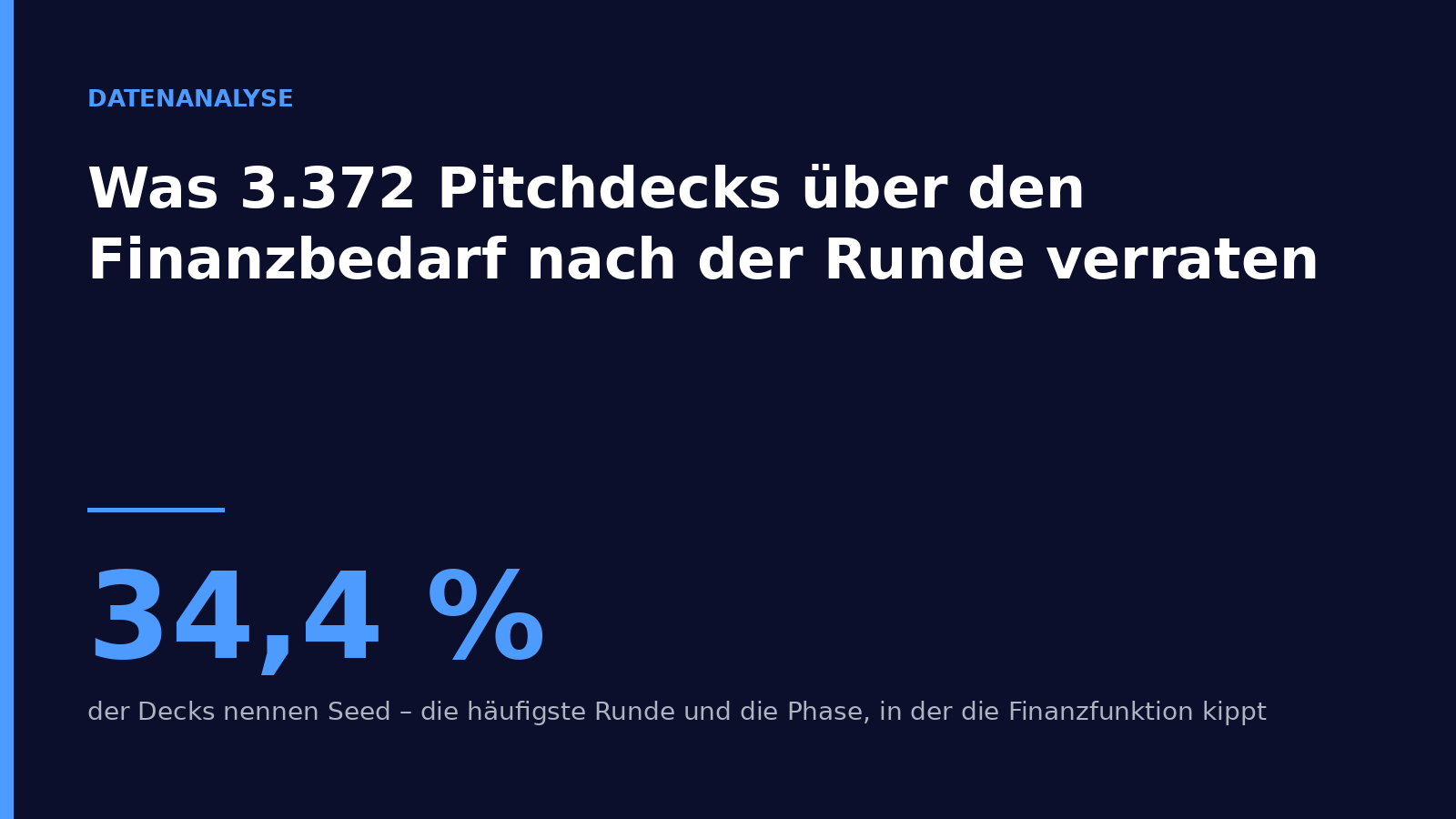
Seed is the most frequently named specific round (34.4 percent of decks), Series A follows at 21.7 percent. Pre-seed sits at 5.3 percent, Series C at 5.7 percent, everything from Series E upwards at 1.7 percent combined.
One methodological caveat belongs here, and it is important enough to repeat: the field allows multiple values, and 65.7 percent of decks carry more than one. The shares therefore cannot be added up. Read each as the share of decks carrying that value at least once.
For the finance function this range is the critical one. At pre-seed, sound bookkeeping and a financial plan that carries the business model's assumptions are enough. With the seed round the requirement changes abruptly: there are investors who want to be reported to, a capital base whose runway must be answerable at any moment, and usually the first hires in meaningful numbers. By Series A at the latest, reporting has to withstand scrutiny, because it becomes the basis of the next valuation.
The usual mistake is not hiring a CFO too late. It is treating the question as a pure headcount question. Between “bookkeeping is enough” and “a CFO of our own” lie several years and several intermediate steps: a fractional CFO one day a week, an interim CFO for the duration of a fundraise, or CFO as a Service as a permanent part-time arrangement.
A quarter of rounds sit below USD 2.5 million
The distribution of amounts raised: 24.7 percent of decks fall into rounds up to USD 2.5 million, 18.2 percent into 2.5 to 10 million, 22.8 percent into 10 to 50 million, 14.0 percent into 50 to 250 million. Above 250 million, 3.0 percent remain. A fifth of the decks explicitly carry “n.a.” and are reported separately.
The lower half of that distribution is the everyday reality of most companies we work with. On a round of two million dollars and a target runway of 18 to 24 months, the budget left for the entire finance function – bookkeeping, controlling, reporting, planning – will not stretch to an experienced full-time hire, and an inexperienced one will not carry the load. That is the economic reason part-time and outsourced models dominate in this size class, not a lack of ambition.
In practice the question is not “CFO yes or no”, but what share of financial leadership a given budget can fund without operational bookkeeping suffering for it. Our article on the cost of an interim CFO gives the orders of magnitude.
Two thirds SaaS – and therefore two thirds recognition questions
Among the 2,706 decks with a business model on file, SaaS dominates clearly at 66.4 percent. Apps sit at 11.4 percent, e-commerce at 11.2, marketplaces at 6.7 percent.
For the finance function this is the most consequential number in the whole analysis. SaaS companies bill licences in advance, often annually. The money is in the account before the service has been delivered. If revenue is not recognised over the contract term, the profit and loss account shows a picture with little relation to the business – and deferred revenue is regularly the first line an investor opens in due diligence.
On top of that, the metrics that steer a SaaS business – recurring revenue, the bridge from new business, expansion and churn, retention in the installed base – do not arise in the ledger. They come from connecting contract data, the billing system and financial accounting. That connection is missing in most setups after the seed round. Building it is one of the most frequent tasks in our mandates, and the reason we keep a dedicated service description for this segment.
For e-commerce and marketplaces, together around 18 percent, the questions differ but the effect is the same: multi-level contribution margin accounting and returns provisions in retail, the gross-versus-net presentation question on platforms.
Fintech leads the sectors – with consequences for finance
Fintech is the most common sector at 14.1 percent (428 of 3,034 decks with a sector stated), ahead of AI/ML/big data at 9.9 percent and health tech at 8.0 percent. In total the decks spread across 58 categories.
Fintech companies generally face regulatory reporting duties earlier than others, often requirements to segregate client money from their own, and an audit that starts well before the first statutory one. Anyone founding in this field needs a robust finance function not from Series A, but from the first licence.
What the data does not say
A dataset is worth only as much as its limits are disclosed. Four caveats apply to everything above:
- The collection ends in 2023. For 2023, 154 decks are recorded; for 2022, 531. The set reflects a stock weighted towards 2019 to 2022, not the current state of the market.
- It is a curated collection, not a full survey of the market. The distributions also reflect which decks became publicly available in the first place.
- The sector taxonomy overlaps. Categories such as software, internet and technology are fuzzy. The shares are orders of magnitude, not exact market segmentation.
- We deliberately say nothing about the B2B/B2C split. The field is empty for 77.4 percent of decks. A number could be calculated from the rest, but not defended.
Frequently asked questions
At which funding round does a startup need a finance function?
In practice from the seed round. With the first institutional capital come reporting duties towards investors, a cash runway that must be answerable at any time, and the first hires in meaningful numbers. Seed is also the most frequent round in our database at 34.4 percent – the range in which most companies cross that threshold.
When is a CFO of your own worth it rather than an external model?
When complexity permanently occupies a full-time capacity: several entities, international structures, a larger finance team, or a transaction process running for months. On rounds below USD 2.5 million – roughly a quarter of all decks – that is as a rule not yet the case.
Why is revenue recognition so often a problem in SaaS?
Because billing happens in advance. Cash receipt and delivery of the service fall apart, sometimes by twelve months. Without clean recognition over the contract term, the profit and loss account deviates systematically from the actual course of business. Since two thirds of the decks analysed are SaaS models, this affects the majority of funded companies.
Do the figures transfer to the German market?
Only partly. 44.5 percent of the decks come from the United States, 14.5 percent from Germany. The distribution of rounds and business models transfers as a pattern; the absolute amounts only to a degree, because rounds in the German market are on average smaller at comparable stages.
Read on
- State of Startup Pitch Decks – the full analysis with sector, round and country distributions and disclosed methodology.
- CFO as a Service – what the model covers and where the line to consulting runs.
- Fractional CFO – part-time financial leadership on a permanent basis instead of a full-time role.
- Interim CFO, CFO as a Service or a permanent hire? – the decision guide for the phase after the round.
- CFO as a Service: modules and pricing models – which scope fits which company stage.
- CFO as a Service at nugrow – what the collaboration looks like in practice.
Source
Pitch deck database of derStartupCFO, full extraction as at 31 August 2026: 20,243 recorded slides, grouped by company into 3,372 decks from 67 countries. Percentages to one decimal place. The reference base in each analysis is the number of decks carrying at least one value in the field concerned. Full methodology and limitations in the source report. As of September 2026.