
The short answer
At nugrow an interim CFO costs from EUR 1,800 per day, excluding VAT. The other roles start lower: head of finance from EUR 1,300, FP&A from EUR 1,150, controlling from EUR 1,050, accounting from EUR 850. All rates and a cost calculator are on the pricing page.
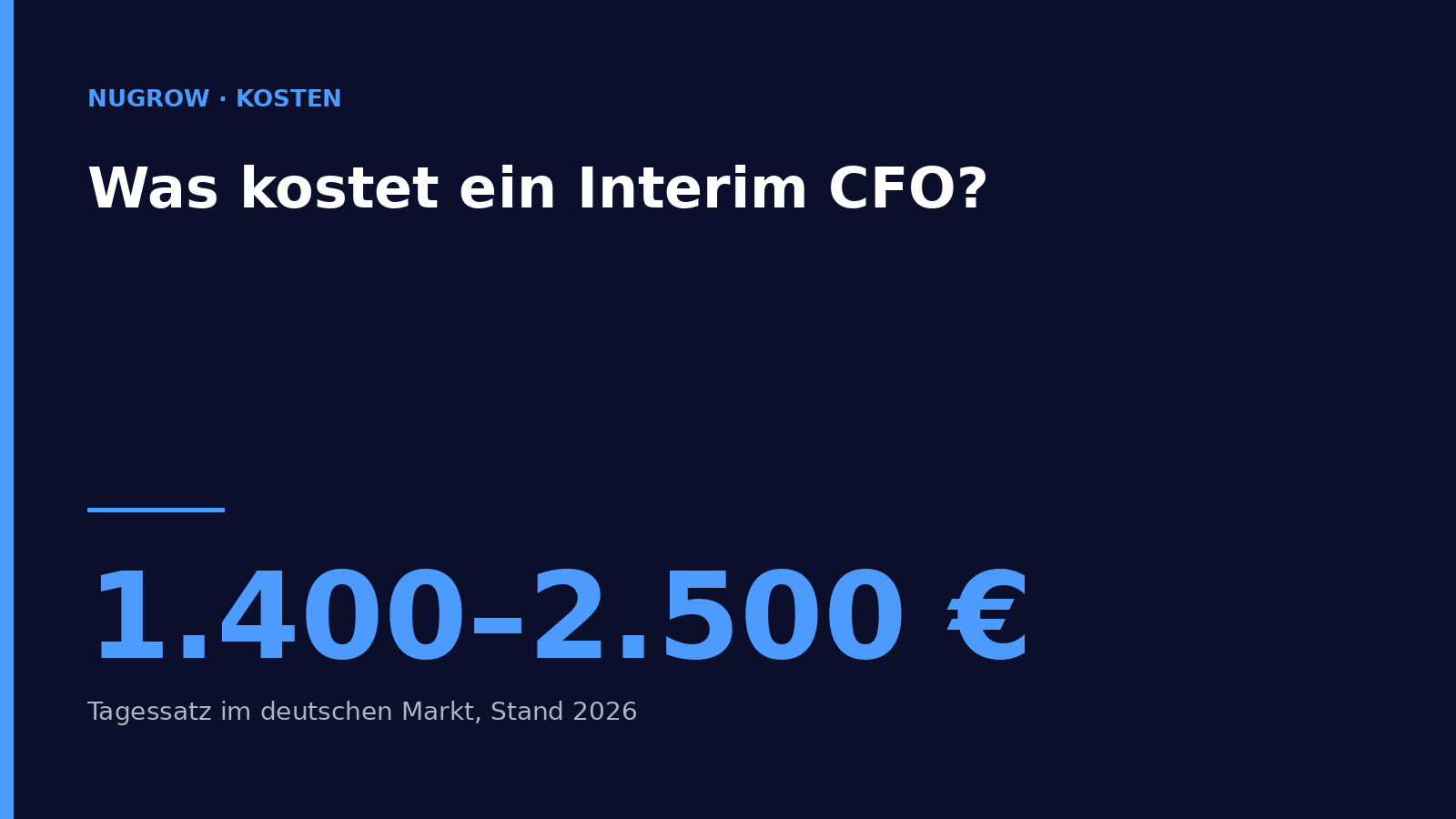
For comparison, the wider market: according to public surveys, interim CFOs in Germany cost EUR 1,400 to 2,500 per day, and EUR 3,000 and above in restructurings and large-group environments. The average across all interim functions is EUR 1,317 according to the DDIM market study for 2026. These market values describe other providers, not nugrow's terms. Sources are at the end.
Day rates at nugrow
| Role | Day rate from (excl. VAT) | Typical trigger |
|---|---|---|
| Interim CFO | EUR 1,800 | Leadership vacancy, funding round, transaction, exit |
| Interim head of finance | EUR 1,300 | Leading the team and month-end close, without a CFO role |
| FP&A | EUR 1,150 | Planning, forecasting, investor reporting |
| Controlling | EUR 1,050 | Building reporting, month-end close, system migration |
| Accounting | EUR 850 | Closing backlog, parental leave cover, absence |
The actual rate depends on project, workload and duration. The budget is the day rate times the agreed days; there is no fixed monthly package.
Market day rates by role (all providers)
Not every vacancy in a finance department needs a CFO. The difference between finance leadership and controlling is quickly EUR 1,000 a day – so the first question is which role actually has to be filled.
| Role | Market range per day | Typical trigger |
|---|---|---|
| Interim CFO, finance leadership | EUR 1,400–2,500 | Leadership vacancy, funding round, transaction |
| Interim CFO in restructuring or a listed group | from EUR 3,000 | Turnaround, carve-out, post-merger integration |
| Controlling | EUR 800–1,200 | Building reporting, project controlling, system migration |
| Accounting and financial reporting | EUR 880–1,120 | Bridging a close, parental leave cover, clearing a backlog |
| HR leadership | EUR 800–1,500 | for comparison, outside finance |
Between controlling and CFO sits a role that is often needed but rarely named as such: the interim head of finance. They lead the team and the month-end close, while financing and investor talks stay with management or the CFO. At nugrow this role starts at EUR 1,300 per day.
What moves the rate up and down
Up: crisis and turnaround situations, because liability and pressure rise. Group environments with IFRS consolidation. A start at very short notice. Sectors requiring specialist knowledge, such as regulated financial services. And locations that demand daily on-site presence.
Down: longer engagements with predictable utilisation. Part-time rather than full-time. Remote work. And direct engagement: going through a provider typically adds 25 to 35 percent on top of the rate the individual charges. That is not a hidden fee – it pays for selection, contracting and cover if the person drops out – but it is worth knowing what you are paying for. The routes to an interim CFO besides a provider are covered in a separate article.
The three billing models
Day rate. The standard in interim management. Days worked are billed, usually monthly. Advantage: precise attribution. Disadvantage: hard to budget when scope fluctuates.
CFO as a Service. Ongoing part-time support. At nugrow, CFO as a Service is budgeted using the agreed day rate and workload. An estimated monthly budget helps planning; billing follows the agreed scope, not a fixed monthly package.
Fixed project price. For clearly bounded work – a financial model, a due diligence, a system implementation. Requires a solid statement of work, otherwise the fixed price turns into a change-request negotiation.
Worked example: six months of finance leadership
Assume the head of finance is unavailable and the role has to be bridged for six months. Four days a week is roughly 104 billable days.
| Scenario | Calculation | Cost |
|---|---|---|
| nugrow, interim CFO | 104 days × EUR 1,800 | EUR 187,200 |
| Market, lower end | 104 days × EUR 1,400 | EUR 145,600 |
| Market, middle | 104 days × EUR 1,950 | EUR 202,800 |
| Market, upper end | 104 days × EUR 2,500 | EUR 260,000 |
| Market, middle, reduced to 3 days/week | 78 days × EUR 1,950 | EUR 152,100 |
The comparison with a permanent hire is usually drawn wrongly. The median for CFO positions in Germany is around EUR 114,400 gross per year according to StepStone salary data; adding employer social contributions, bonus and workplace costs gives fully loaded annual costs of roughly EUR 140,000 to 190,000 in the Mittelstand and EUR 180,000 to 300,000 at the upper end. Spread over six months that is EUR 70,000 to 160,000 – apparently far cheaper.
Except that the role cannot be filled within six months. Factor in the usual six to nine months to hire, and over that period the permanent hire costs nothing and delivers nothing. An honest comparison needs a 24-month horizon and has to count the months the seat sits empty.
When the engagement pays for itself
An interim day rate only means something relative to the damage the vacancy does. Three yardsticks:
- A delayed funding round. If reliable numbers are missing and closing slips by a quarter, that costs more than the entire engagement, depending on runway.
- Missed reporting deadlines. Without finance leadership, monthly and annual closes slip. With bank covenants or investor reporting in place, that is not a cosmetic problem.
- Decisions flown blind. Three months of steering without a cash forecast means decisions made on the basis of bank balances.
How to spot an inflated rate
A high day rate is not automatically too expensive. It becomes a warning sign when the provider cannot name comparable projects, when it stays unclear who will actually do the work, or when onboarding is treated as billable delivery. The reverse also holds: a cheap rate does not help if onboarding takes twice as long. What matters is the cost to reach a result, not the cost per day.
Comparing offers: five checks
- Check the scope: what is included, what is not? A low day rate with a narrow scope can end up more expensive.
- Results instead of hours: define what should exist after the term, for example a month-end close within a set time or a finished plan.
- References: ask for comparable engagements and what remained afterwards.
- Travel and ancillary costs: clarify in advance whether they are charged separately.
- Term and termination: an engagement should be adjustable if needed.
What to clarify in advance
The clearer the goal, the more precise the offer. Helpful are the current state of the finance function, the main tasks for the next months, the time frame and whether a leader or a reporting specialist is needed. For the latter, an interim controller or support through interim accounting and FP&A is often enough. For the leadership level, see Interim CFO.
A note for international buyers
Two things regularly surprise buyers outside Germany. First, an interim CFO here is normally engaged as an independent contractor under a service contract, not employed – and the boundary to false self-employment and to licensed temporary agency work is enforced, with real consequences for the client. The contract article covers what has to be in the agreement. Second, rates are quoted per day and net of VAT; 19 percent German VAT is added on top and is usually recoverable for the client.
Frequently asked questions
What does an interim CFO cost per day?
At nugrow from EUR 1,800 per day, excluding VAT. Across the German market interim CFOs cost EUR 1,400 to 2,500, and EUR 3,000 and above in restructuring and large-group projects.
What does an interim controller cost?
At nugrow from EUR 1,050 per day, interim accounting from EUR 850, both excluding VAT. Across the market controlling runs at EUR 800 to 1,200 and accounting at EUR 880 to 1,120, which corresponds to EUR 110 to 140 per hour.
How much margin does a provider add?
Typically 25 to 35 percent on top of the rate of the person placed. In return the provider handles selection, contracting and usually cover if the person becomes unavailable.
Is billing done daily or monthly?
CFO support at nugrow starts at EUR 1,800 per day, excluding VAT. The budget is the agreed day rate multiplied by the agreed workload. Eight days, for example, cost EUR 14,400 excluding VAT; this is a worked example, not a monthly package.
How many days per week make sense?
That depends on the task. For reporting and planning, one to two days per week are often enough; for fundraising, transactions or crises, at times more.
Is an interim CFO more expensive than a permanent hire?
Per day yes, over a fixed-term engagement often not. The comparison has to include the six to nine months it takes to fill the role and the cost of the vacancy, otherwise it is systematically biased towards the permanent hire.
Read on
- Pricing: day rates and workload-based budgets at a glance – all rates by role, the billing models and a cost calculator on one page.
- Interim head of finance – when the team needs a lead but not a CFO.
- Fractional CFO, outsourced CFO, part-time CFO: what the terms actually mean – which label fits which situation.
- How to find an interim CFO – the four routes to a provider and twelve selection criteria.
- Interim management in the finance department – roles, process and the first 90 days.
- Interim management for your finance function – how an engagement with nugrow actually runs.
Sources
Day-rate ranges by function: Interim Profis. Market average, utilisation and market volume: DDIM market study 2026. Entry day rate for interim CFOs: Robert Walters. Hourly and daily rates for accounting and the provider margin: Effizienzbuchhalter. Fully loaded cost of a permanent hire: MRH Beratung. CFO salary median: StepStone. All market figures as of August 2026; they describe the market, not the terms of any single provider. nugrow's day rates are from the nugrow price list, as of October 2026.