
The short answer
For an independent interim CFO with a bounded assignment, the German Dienstvertrag – a service contract – is the standard case. But if the person is in practice managed under instruction and fully integrated into the organisation, the arrangement can be reclassified as Scheinselbstständigkeit, bogus self-employment. In that situation Arbeitnehmerüberlassung, temporary staffing through a licensed provider, is the legally safe route.
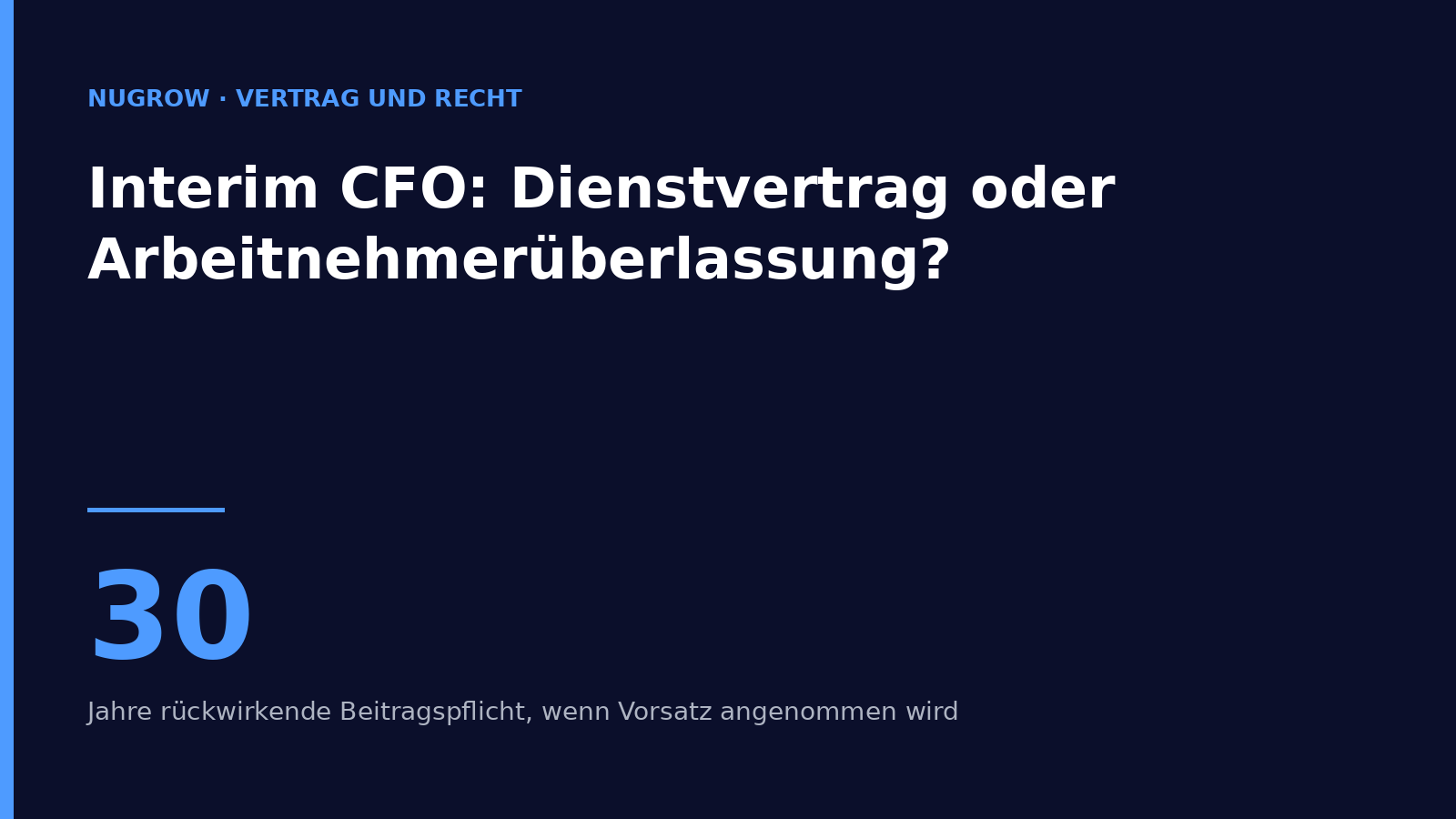
The point that tends to get lost in provider conversations: the consequences of a misclassification fall mainly on the client company. It owes the social security contributions in full – both the employer and the employee share – retroactively for up to four years, and up to thirty where intent is assumed. That is why the contract form is not a formality to leave to the provider.
Disclosure: nugrow works in interim management itself. This piece describes German law as it stands, including where it argues against the convenient option. It is not legal advice; when in doubt, the contract belongs with your own lawyer before signature.
The three contract forms
| Form | What is owed | Who may give instructions | When it fits |
|---|---|---|---|
| Dienstvertrag (service contract) | An activity, not a specific result | nobody – the manager is self-employed | Bounded assignment, own work organisation, several clients |
| Arbeitnehmerüberlassung (temporary staffing, AÜG) | Provision of labour to the hiring company | the hiring company | Genuine integration, subject to instruction, bridging a regular position |
| Werkvertrag (contract for work) | A specific, acceptable result | nobody – the contractor owes the work product | A clearly deliverable output, such as a financial model or an expert opinion |
For ongoing leadership work the Werkvertrag is effectively out: running a finance function is not a deliverable that can be accepted or rejected. The real choice is between service contract and temporary staffing.
The uncomfortable part: bridging a vacancy
In its guidance on interim management and temporary staffing, the German interim management association DDIM makes clear that there is no per-se classification of interim managers as self-employed – the legal assessment always depends on the individual case. It names two constellations in which, in its view, an assignment should not be structured as self-employment:
- pure bridging of a vacancy – a position otherwise held by an employee and filled by one again afterwards;
- service as a dependent managing director without a majority shareholding.
This is uncomfortable because bridging a vacancy is the single most common trigger for an interim CFO assignment. Replacing an absent head of finance one-to-one, with the same duties, the same reporting lines and the same presence, sits closer to temporary staffing than a proposal quoting a day rate suggests.
That does not mean every interim CFO has to run through the AÜG. It means the question has to be asked and answered – with reasoning, documented, before the start.
What the status turns on
The benchmark is § 7 SGB IV. The Deutsche Rentenversicherung does not work through a checklist but performs an overall weighing of all circumstances. Two criteria carry particular weight.
| Criterion | Points to self-employment | Points to employment |
|---|---|---|
| Subject to instruction | Own scheduling, outcomes rather than task lists, substitution possible | Fixed working hours, detailed task specifications, no right of substitution |
| Integration | Own equipment, own location, participation only where the project requires it | Fixed desk on site, company email address, attendance at internal standing meetings |
| Entrepreneurial risk | Own pricing, liability, investment, exposure to non-payment | Fixed remuneration without own risk |
| Market presence | Several clients, own website, own business development | Effectively a single client over a long period |
None of these decides on its own. But a company email address, a fixed desk and a seat at the weekly leadership meeting form a pattern in aggregate – and patterns are what an audit looks at.
What happens if it is reclassified
| Consequence | Extent | Basis |
|---|---|---|
| Social security contributions | Employer and employee share, owed by the client company | § 28e SGB IV |
| Retroactive reach | four years; thirty years where intent is assumed – conditional intent suffices | § 25 SGB IV |
| Recovering the employee share | only by deduction from the next three wage payments – practically impossible where no employment relationship exists | § 28g SGB IV |
| Tax | Payroll tax corrections; input VAT claimed on the contractor's invoices falls away | – |
| Criminal liability | Up to five years' imprisonment or a fine; in particularly serious cases six months to ten years | § 266a StGB |
The decisive asymmetry is in row three: the company owes both shares but cannot in practice recover the employee share. The interim manager who went along with the arrangement carries considerably less economic exposure.
The status determination procedure
Certainty does not require guesswork. Under § 7a SGB IV, either party can apply to the Deutsche Rentenversicherung Bund for a binding determination of employment status. The decision binds across all branches of social insurance and limits retroactive claims.
In practice the procedure is used rarely, because it takes time and because nobody enjoys asking a question whose answer might be inconvenient. For an assignment running several months with leadership responsibility, it is the cheapest insurance available.
The limits of temporary staffing
- Maximum assignment duration of 18 months with the same hiring company, calculated per person rather than per position (§ 1 Abs. 1b AÜG).
- A break of three months and one day resets the clock.
- Collective agreements may set different durations; without collective bargaining coverage an opening clause allows up to 24 months.
- If the limit is exceeded, the staffing contract becomes void and an employment relationship with the hiring company is deemed to exist – unless the person files a retention declaration (§§ 9, 10 AÜG). Back claims follow, along with a fine of up to 30,000 euros.
For a typical interim assignment of around seven months the 18-month limit is not an issue. On extensions in restructuring or transaction projects it becomes one quickly – and then it belongs in the planning, not in the post-mortem.
Seven points that belong in the contract
- The contract form – and the reasoning for it. Not just “service contract”, but why this form fits the actual activity.
- The brief as an outcome, not a position. What has to exist by when. It supports the self-employed status and makes the assignment steerable.
- Freedom from instruction, explicitly. Under a service contract: no requirements on working time and place beyond what the task genuinely needs.
- Right of substitution. Whether and how the person may send a substitute – an indicator that carries weight in the assessment.
- Cover arrangement. What happens on illness or termination, and who bears onboarding the replacement.
- Knowledge transfer. Documentation and handover as part of the scope of work, not a gesture at the end.
- Under the AÜG: licence and deadlines. Proof of the provider's licence, start date, calculation of the maximum duration, and how extensions are handled.
Frequently asked questions
Service contract or temporary staffing for an interim CFO in Germany?
A service contract is the standard case for an independent interim manager with a bounded assignment. Where integration and subordination to instruction are genuine – typically when bridging a regular position – temporary staffing through a licensed provider is the safe route. According to the DDIM there is no blanket classification of interim managers as self-employed.
Who is liable in a case of bogus self-employment?
Mainly the client company. Under § 28e SGB IV it owes the social security contributions in full, both the employer and the employee share. The employee share can only be recovered through the next three wage payments under § 28g SGB IV – which, absent an employment relationship, means effectively not at all.
How far back can contributions be claimed?
Under § 25 SGB IV, four years after the end of the calendar year in which they fell due. Where intent is assumed it is thirty years; conditional intent is enough.
Which criteria does the Deutsche Rentenversicherung apply?
An overall weighing under § 7 SGB IV. Particular weight goes to subordination to instruction – fixed working hours, detailed task specifications, no right of substitution – and to integration, such as a fixed desk on site, a company email address and attendance at internal standing meetings.
What is the status determination procedure?
A procedure under § 7a SGB IV that lets either party obtain a binding determination of employment status from the Deutsche Rentenversicherung Bund. The decision applies across all branches of social insurance and limits retroactive claims.
How long may an interim manager work under temporary staffing?
18 months with the same hiring company, calculated per person rather than per position (§ 1 Abs. 1b AÜG). A break of three months and one day resets the clock. Collective agreements may differ; without collective bargaining coverage an opening clause allows up to 24 months.
What happens if the maximum duration is exceeded?
The staffing contract becomes void and an employment relationship with the hiring company is deemed to exist, unless the person files a retention declaration (§§ 9, 10 AÜG). Back claims follow, plus a fine of up to 30,000 euros.
Does the interim manager having their own GmbH prevent reclassification?
Not automatically. What counts is the actual circumstances of the work, not the contractor's legal form.
Further reading
- How to find an interim CFO – the four routes to a provider and twelve selection criteria, the contract question included.
- Interim management in the finance department – roles, how an assignment runs and the first 90 days.
- Interim management for the finance function – how an engagement with nugrow works in practice.
Sources and note
Status assessment and overall weighing: § 7 SGB IV. Status determination procedure: § 7a SGB IV. Employer's liability for contributions: § 28e SGB IV. Recovery of the employee share: § 28g SGB IV. Limitation periods: § 25 SGB IV. Penalty range: § 266a StGB. Maximum assignment duration and legal consequences: § 1 Abs. 1b and §§ 9, 10 AÜG. Classification of interim management: DDIM guidance on interim management and temporary staffing through providers. Practitioner summaries: IHK München, Handelskammer Hamburg, Haufe and selbststaendigkeit.de. As of September 2026.
This article is an overview and not legal advice. The assessment always depends on the individual case. Before signature the contract belongs with a lawyer specialising in German employment and social security law – not afterwards.