
The short answer
In the first six weeks of a restructuring the finance function has to establish three things, in this order: transparency over cash, clarity about the legal position, and a defensible set of numbers for the conversations with banks and shareholders. Everything else – the action plan, the cost programme, the negotiating strategy – builds on that and is worthless without it.
The most expensive mistake is the reverse order: discussing measures first and calculating afterwards. Walking into a bank meeting with unsupported figures and having to correct them at the next one costs the thing the whole restructuring rests on – credibility.
Week 1: cash on the table
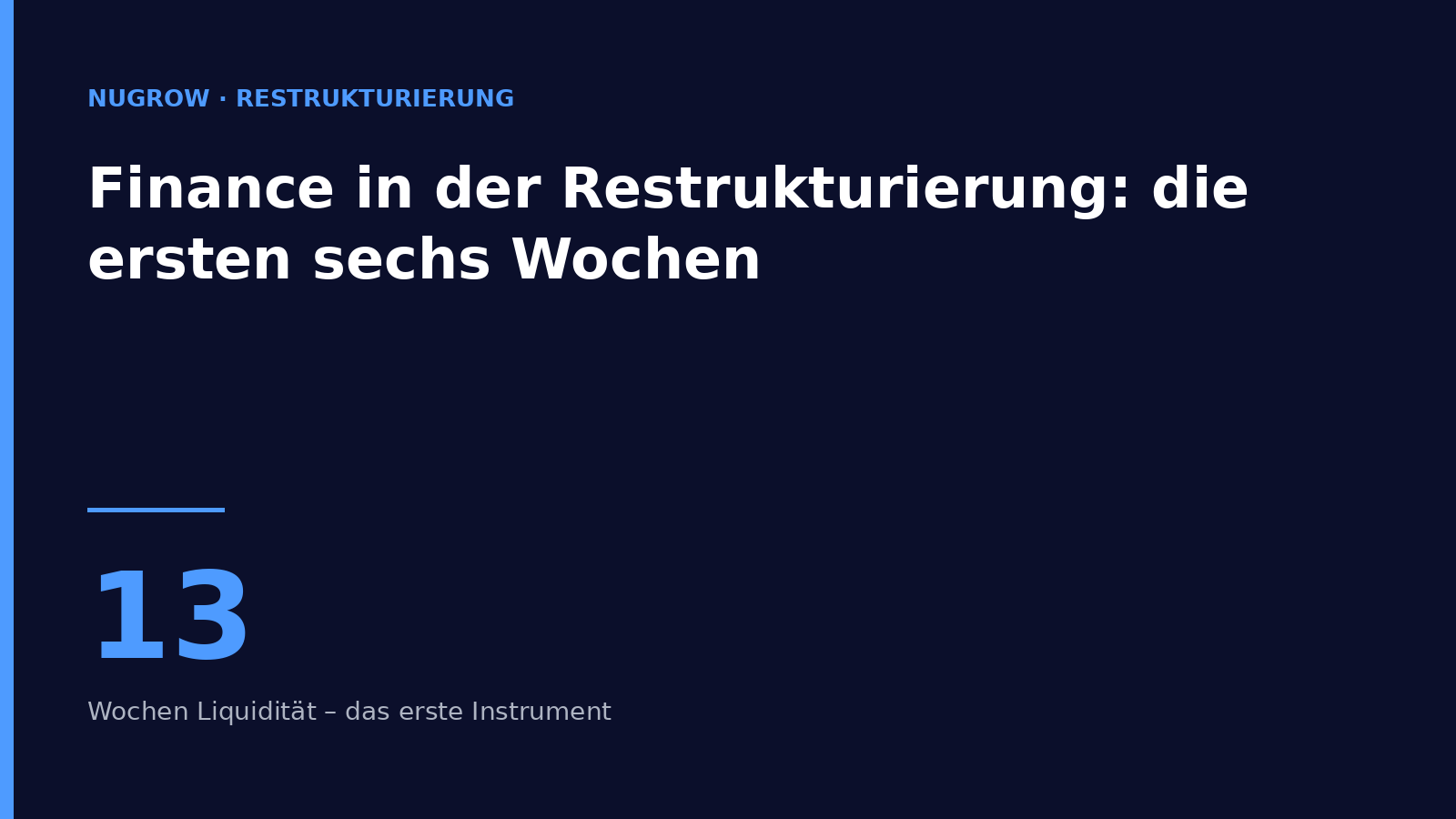
The first step is always the same, whatever the sector or size: a 13-week cash flow forecast, built directly from payment flows, week by week, using realistic payment behaviour rather than agreed payment terms.
Four schedules belong with it, and experience says none of them is ever complete when a crisis starts:
- Receivables by due date, with an honest assessment of what will actually arrive.
- Payables by due date – including the invoices that have not been booked yet.
- Mandatory payments: social security contributions, wage tax, VAT, loan amortisation, insurance, rent. They fall due regardless of the situation and are the most common source of nasty surprises.
- Credit lines and collateral: what is committed, what is drawn, what is pledged against what, and which covenants bite when.
Social security contributions deserve their own sentence. Withholding the employee portion is a criminal offence under section 266a of the German Criminal Code and attaches to the managing directors personally. In any prioritisation of payments this item therefore sits somewhere quite different from a supplier invoice.
Week 2: establish the legal position
In parallel, not afterwards, the question of where the company stands legally has to be answered. Three states must be distinguished, and the duty to file hangs on them:
| State | Meaning | Consequence |
|---|---|---|
| Imminent illiquidity (section 18 InsO) | Forecast over as a rule 24 months | No duty – but access to the StaRUG |
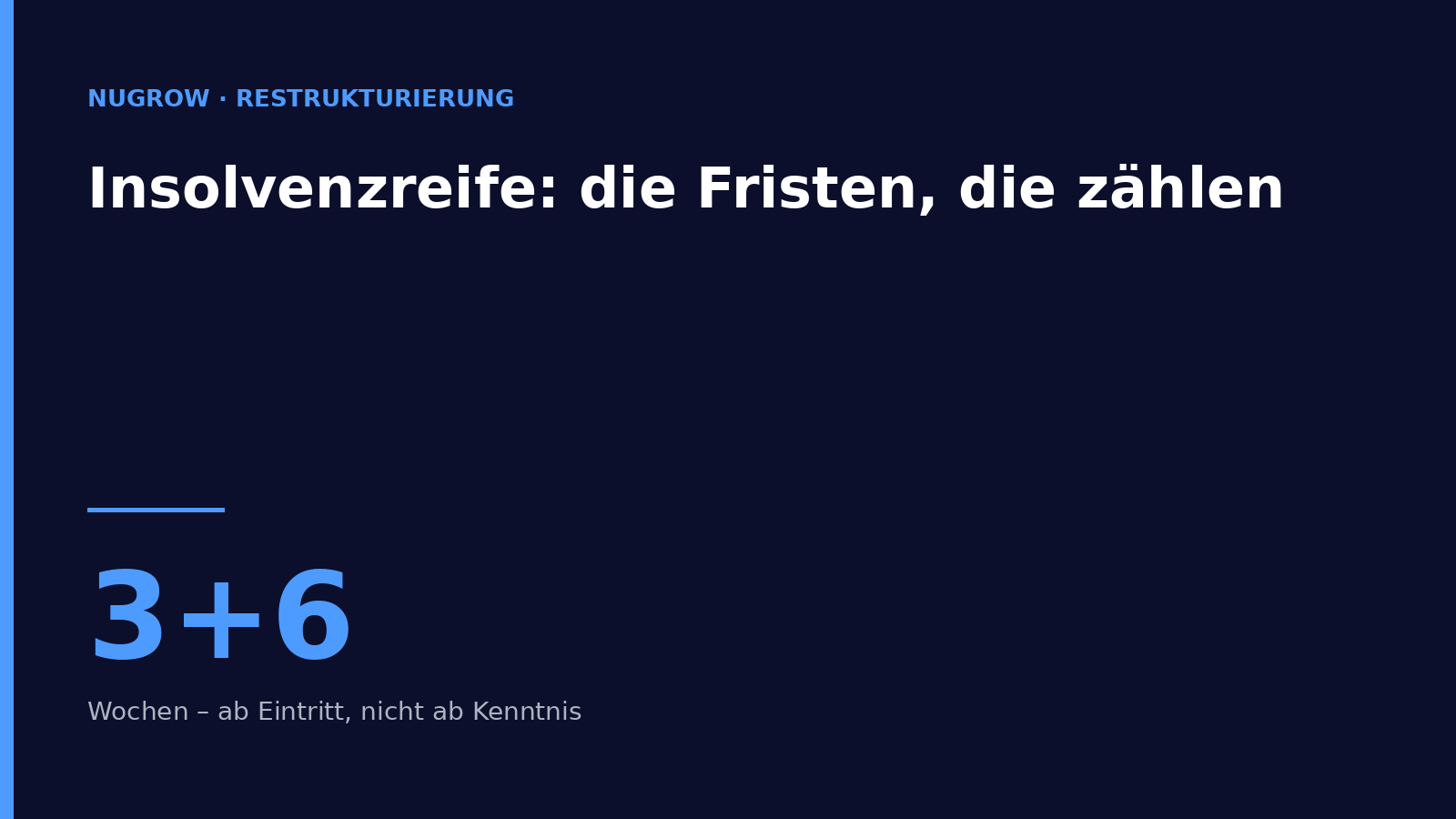
| Illiquidity (section 17 InsO) | Liabilities due cannot be serviced | File within three weeks |
| Over-indebtedness (section 19 InsO) | Balance-sheet shortfall and a negative going-concern forecast | File within six weeks |
That classification is not for the finance function alone – it belongs in a conversation with a law firm specialised in insolvency law. What finance delivers is the arithmetic: a liquidity status for section 17 InsO, and a documented twelve-month going-concern forecast as soon as a balance-sheet shortfall is on the table. The detail is in the article on the deadlines of insolvency maturity.
Weeks 3 and 4: the numbers the negotiation runs on
Now the material that will be negotiated with takes shape. Banks and shareholders expect four components almost without exception:
- The rolling 13-week forecast with plan-versus-actual for the preceding weeks. The variance analysis matters more than the projection: it shows whether the numbers can be trusted.
- An integrated plan over twelve to 24 months linking earnings, balance sheet and cash.
- The root-cause analysis. Why did the situation arise – volume, margin, working capital, one-off effects, financing structure? Without a clean derivation, every action plan looks arbitrary.
- An action plan with cash effect. Per measure: effect in euros, timing of the effect, cost to implement, owner. Measures without a date are worthless in a crisis, because the date is precisely what matters.
Weeks 5 and 6: the bank meeting
Anyone who has to approach lenders in a crisis should keep three things in mind.
Early rather than late. A bank that learns of a deterioration from the reporting it was sent reacts differently from one that was told in advance. Timing of information is the one factor management controls entirely.
Complete rather than polished. A figure that has to be corrected at the second meeting costs more trust than the original bad news would have. Uncertainties belong named, not hidden.
With a proposal rather than a request. “We need more time” is not a negotiating position. “We need amortisation suspended in the amount of X until 31 March, in return we will implement the following measures, and this is what cash looks like afterwards” is one.
If the bank asks for a restructuring opinion under IDW S 6, that is not a vote of no confidence but its own protection. The better the numbers are prepared, the shorter and cheaper the exercise.
The five mistakes that sink more restructurings than the business does
- Starting too late. The StaRUG is only open while the company is merely imminently illiquid. Waiting until cash is tight forfeits the instrument with the widest room for manoeuvre.
- Optimistic planning. A cash forecast that turns out to have been too positive costs more trust in a crisis than a bad number does. Plan conservatively and surprise on the upside.
- Communication by accident. Banks, shareholders, credit insurers, key suppliers and staff need coordinated messages and a timetable. Contradictory statements from inside the company are a common and avoidable form of damage.
- Costs only, no cash. Headcount reduction hits earnings quickly but cash late – severance and notice periods cost money first. Working capital works the other way round: fast on cash, barely on earnings. In a crisis the cash effect comes first.
- No documentation. Who decided what, when and on what basis is what settles the liability question afterwards. That documentation is created during the restructuring or not at all.
Why the role is often filled externally
Restructuring is one of the five typical triggers for an interim CFO mandate, and the reasons have less to do with technical skill than with the constellation.
The incumbent finance leadership is part of the story that now has to be explained – which complicates the conversation with banks regardless of the quality of their work. The additional load is substantial and lasts six to twelve months, then stops. And the task calls for experience of a process one ideally goes through rarely: anyone handling a restructuring for the first time learns it under the worst possible conditions.
Day rates in this segment sit above the market average – from around EUR 3,000 for interim CFO mandates in restructuring and group environments, against EUR 1,400 to 2,500 in the normal case. The context is on our pricing page.
Frequently asked questions
What does a CFO do first in a restructuring?
Establish transparency over cash: a 13-week forecast built directly from payment flows, receivables and payables by due date, the mandatory payments and the status of credit lines. Without that basis, neither the legal position can be assessed nor a negotiation with banks conducted.
How long does a restructuring take in the finance function?
The intensive phase typically lasts six to twelve months. The first six weeks decide the starting position, the first quarter decides credibility with the lenders.
When should you talk to the bank?
Before the bank notices by itself. A deterioration communicated in advance together with a proposed course of action is a conversation; the same deterioration discovered in submitted reporting is a trust problem – and trust is the currency this phase is paid in.
Do we need a restructuring opinion?
Whenever lenders have to decide on extension, standstill or new money. The IDW S 6 opinion is their protection against clawback and liability risk and demonstrates restructuring viability in three stages: ability to continue, competitiveness and ability to earn a return.
What does an interim CFO cost in a restructuring?
Well above the market average of around EUR 1,317. For restructuring and group mandates rates start at around EUR 3,000 per day, because responsibility for the outcome, time pressure and proximity to liability all push the rate up.
Read on
- Insolvency maturity: the deadlines – three and six weeks, twelve and 24 months in context.
- 13-week cash flow forecast – structure, method and the four mistakes.
- Restructuring opinion under IDW S 6 – contents, stages and preparation.
- Interim CFO references – twelve mandates, including a restructuring with exit preparation.
- Interim management for your finance function – available within 24 hours.
Sources and status
Legal framing: sections 15a, 17, 18 and 19 InsO, section 266a of the German Criminal Code, sections 1 and 29 StaRUG; restructuring concepts under IDW S 6 in its 2023 version. Day rates: DDIM market study 2026 and the ranges on our pricing overview. The remaining statements draw on nugrow's mandate practice. As of September 2026. This article is an overview, not legal or tax advice.