
The short answer
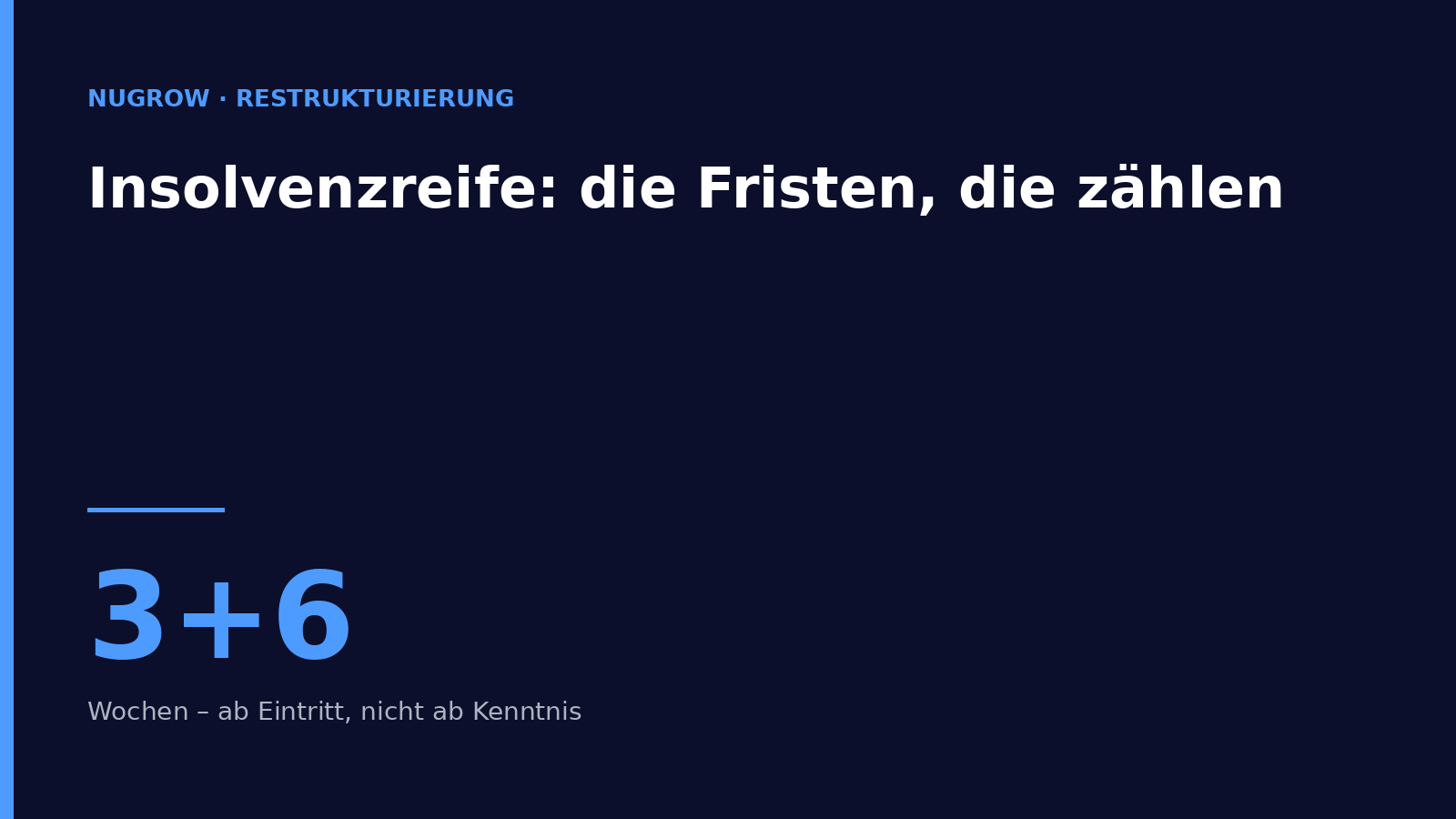
German insolvency law puts a hard duty on the directors of limited-liability companies: once the company is insolvent in the legal sense, they must file. Four periods govern the point at which financial difficulty becomes a legal obligation.
| Measure | Period | Provision |
|---|---|---|
| Filing deadline on illiquidity (Zahlungsunfähigkeit) | 3 weeks | Section 15a(1) InsO |
| Filing deadline on over-indebtedness (Überschuldung) | 6 weeks | Section 15a(1) InsO |
| Forecast horizon of the going-concern prognosis | 12 months | Section 19(2) InsO |
| Forecast horizon for imminent illiquidity | 24 months | Section 18(2) InsO |
On top of these sits a threshold developed by the courts for illiquidity itself: a liquidity gap of ten percent or more of total liabilities then due, which cannot be closed within three weeks.
The sentence that matters most in practice is in none of the statutes: the clock starts when the ground for insolvency objectively arises, not on the day someone notices it. Looking late does not buy time. It spends it.
This article frames the deadlines from the finance function's point of view. It is not legal advice; assessing an individual case belongs with a law firm specialising in insolvency and restructuring.
A note for readers outside Germany
Two features of the German regime surprise people used to other jurisdictions. First, filing is a duty, not an option: directors do not get to decide whether an insolvency process is in the company's interest. Second, the duty is personal. Missing the deadline is a criminal offence and exposes directors to personal liability for payments made after the company became insolvent. There is no equivalent of a debtor-in-possession filing that a board chooses at leisure, and the deadlines are measured in weeks, not months.
The terms below are the German legal terms. They are kept in German with an explanation because they have no clean English equivalent: Zahlungsunfähigkeit is narrower than “insolvency”, and Überschuldung is a balance-sheet test combined with a forecast, not simply “balance-sheet insolvency”.
Illiquidity: the ten percent threshold
Under section 17(2) InsO a company is illiquid when it cannot meet its payment obligations as they fall due. What that means in numbers was worked out by the Federal Court of Justice (Bundesgerichtshof), principally in its judgment of 24 May 2005 (IX ZR 123/04):
- If the liquidity gap is less than ten percent of total liabilities then due, this is as a rule a mere payment delay, not illiquidity.
- If it is ten percent or more and cannot be closed within three weeks, illiquidity is regularly to be assumed – unless it is near-certain that the gap will shortly be closed in full and creditors can reasonably be expected to wait.
The court confirmed this line in 2017 (II ZR 88/16) and in 2022 added a more workable method (II ZR 112/21): instead of a full liquidity balance sheet, it is sufficient to draw up a liquidity status at three reference dates within a three-week window – available funds against liabilities then due. The threshold and the period were left unchanged.
For practitioners this is the useful part: “are we illiquid?” is a question that can be answered by calculation. It calls for a schedule, not a judgement call – and a company that cannot produce that schedule within hours when it matters has a data problem, not a legal one.
Over-indebtedness: two stages, twelve months
Over-indebtedness under section 19 InsO is a two-stage test. Stage one: assets no longer cover liabilities. Stage two: even so, there is no over-indebtedness in the legal sense if continuation of the business over the next twelve months is more likely than not – the going-concern prognosis, or Fortbestehensprognose.
“More likely than not” means above 50 percent, but it has to be established positively. A prognosis resting on hoped-for funding that has not been committed will not carry.
The pandemic-era relief has expired
Between 9 November 2022 and 31 December 2023 the SanInsKG temporarily shortened the forecast horizon to four months and extended the filing deadline on over-indebtedness to eight weeks. Neither applies any longer. Since 1 January 2024 the figures are twelve months and six weeks again. Anyone still working from the crisis values – and it happens – is assuming headroom that no longer exists.
Imminent illiquidity: the StaRUG window
Section 18 InsO recognises a third state: imminent illiquidity (drohende Zahlungsunfähigkeit). It exists where the company will probably be unable to meet its existing payment obligations when they fall due; the forecast horizon is as a rule 24 months.
This state carries no duty. It is an opportunity. It is the sole entry condition for the StaRUG, Germany's preventive restructuring framework, under which a restructuring plan can be pushed through with a three-quarters majority in each creditor class against individual holdouts – with no insolvency proceedings, no publicity, and management remaining in office.
That is the real message of this article. Between “this is getting tight” and “this is too late” lies a window of up to 24 months in which the room for manoeuvre is at its widest. Once illiquidity or over-indebtedness arrives, the window closes. Using it requires knowing that you are standing in it – and only a company that plans knows that.
The duty that bites earlier
Section 1 StaRUG obliges the directors of limited-liability companies to monitor continuously for developments that threaten the company's survival, to take countermeasures once they identify one, and to report to the supervisory bodies without delay. This duty applies irrespective of any crisis and binds every GmbH managing director and every management board member.
In practice it calls for an early-warning system. That need not be elaborate: a rolling liquidity forecast, an integrated annual plan and defined thresholds at which someone is informed will do for most mid-sized companies.
What the finance function has to deliver
None of these deadlines can be assessed without figures. Four building blocks are enough, and all four are unspectacular:
- A 13-week liquidity forecast, rolled forward weekly, built directly from cash flows. It signals the onset of illiquidity with lead time.
- A liquidity status at the press of a button. Available funds against liabilities then due, at any chosen reference date. That is the calculation section 17 InsO calls for.
- An integrated plan over twelve to 24 months. Profit and loss, balance sheet and liquidity connected – the basis both for the going-concern prognosis and for assessing imminent illiquidity.
- Documentation. Who assessed what, when, and on what basis. When it matters, this is the difference between a defensible decision and the accusation that you should have known.
Frequently asked questions
How long may a company wait before filing?
At most three weeks after illiquidity arises and at most six weeks after over-indebtedness arises (section 15a(1) InsO). These are outer limits, not grace periods: the statute requires a filing without culpable delay. Once it is clear that a restructuring will not succeed, the filing must be made immediately.
When does the clock start?
When the ground for insolvency objectively arises, not when the directors become aware of it. Noticing late leaves correspondingly less time – and the risk still sits with the directors.
How large does the liquidity gap have to be?
Under the case law of the Federal Court of Justice, a gap of ten percent or more of total liabilities then due which cannot be closed within three weeks. Below that threshold there is as a rule only a payment delay.
What is the forecast horizon for over-indebtedness?
Twelve months (section 19(2) InsO). The temporary reduction to four months under the SanInsKG expired on 31 December 2023; the twelve-month horizon has applied again since 1 January 2024.
What is the difference between illiquidity and imminent illiquidity?
Illiquidity is a present state and triggers the duty to file. Imminent illiquidity is a forecast over usually 24 months; it triggers no duty but opens options – above all access to the StaRUG.
Do any pandemic special rules still apply?
No. The SanInsKG special rules – an eight-week filing deadline on over-indebtedness and a four-month forecast horizon – expired on 31 December 2023. Ordinary law has applied again since 1 January 2024, and the federal government stated in 2025 that it plans no change.
Does this apply to a foreign parent's German subsidiary?
The duty attaches to the directors of the German entity, whatever the group's home jurisdiction. A German GmbH with its centre of main interests in Germany falls under the InsO, and its managing directors carry the filing duty personally – including managing directors resident abroad.
Read on
- Duty to file for insolvency – who it binds and what a breach means.
- Going-concern prognosis – horizon, standard, and how it differs from the accounting going-concern assessment.
- StaRUG – instruments, majorities and the time window.
- Finance in a restructuring – what has to happen in the first six weeks.
- Interim management for the finance function – ready to start within 24 hours.
Sources and status
Duty to file and deadlines: section 15a InsO. Illiquidity: section 17 InsO; BGH, judgment of 24.05.2005 – IX ZR 123/04; BGH, judgment of 19.12.2017 – II ZR 88/16; BGH, judgment of 28.06.2022 – II ZR 112/21. Imminent illiquidity: section 18 InsO. Over-indebtedness and forecast horizon: section 19 InsO. Early crisis detection and the restructuring framework: sections 1, 25, 26, 29, 53 StaRUG. Expiry of the SanInsKG special rules on 31.12.2023. As of September 2026. This article is an overview and not legal advice. Every assessment depends on the individual case and belongs, before any decision is taken, with a law firm specialising in insolvency and restructuring law.