
The short answer
In a carve-out, part of a business is separated from a larger group and sold. The finance task behind it has two halves: showing what the unit would have looked like as a standalone company – that is the carve-out balance sheet – and making sure it is actually able to operate from the first day after closing.
The second half is routinely underestimated. A cleanly calculated balance sheet is of little use if on day one nobody can issue an invoice or release a payment.
A note for readers outside Germany
Two things differ from what a foreign sponsor may expect. German entity formation, tax numbers and a VAT identification number run through public authorities with their own lead times that cannot be compressed by paying more. And the transfer of employees follows section 613a of the German Civil Code: staff pass to the buyer automatically, with their existing terms, and they have an individual right to object. Neither point is negotiable between the parties, and both belong in the timetable before the signing date is fixed.
The standalone view
The unit being separated never had figures of its own. It used group contracts, central functions and shared systems. The standalone view reconstructs an independent picture from that, and it has to answer four questions:
- Which assets and liabilities belong to it? Fixed assets, inventory, receivables, provisions, employee obligations – including the cases currently marked “shared use”.
- Which costs were carried centrally? IT, HR, accounting, insurance, legal, management. Those allocations have to be replaced by the actual cost of a standalone structure – not by the existing allocation key.
- Which terms fall away? Purchasing advantages, framework agreements, the group's financing terms. Losing them is often the single largest effect on earnings.
- What stays behind with the seller? The stranded costs – overhead that carries on after the sale because it does not travel with the unit. They do not belong in the valuation of what is sold, but they absolutely belong in the seller's decision.
Day-1 readiness
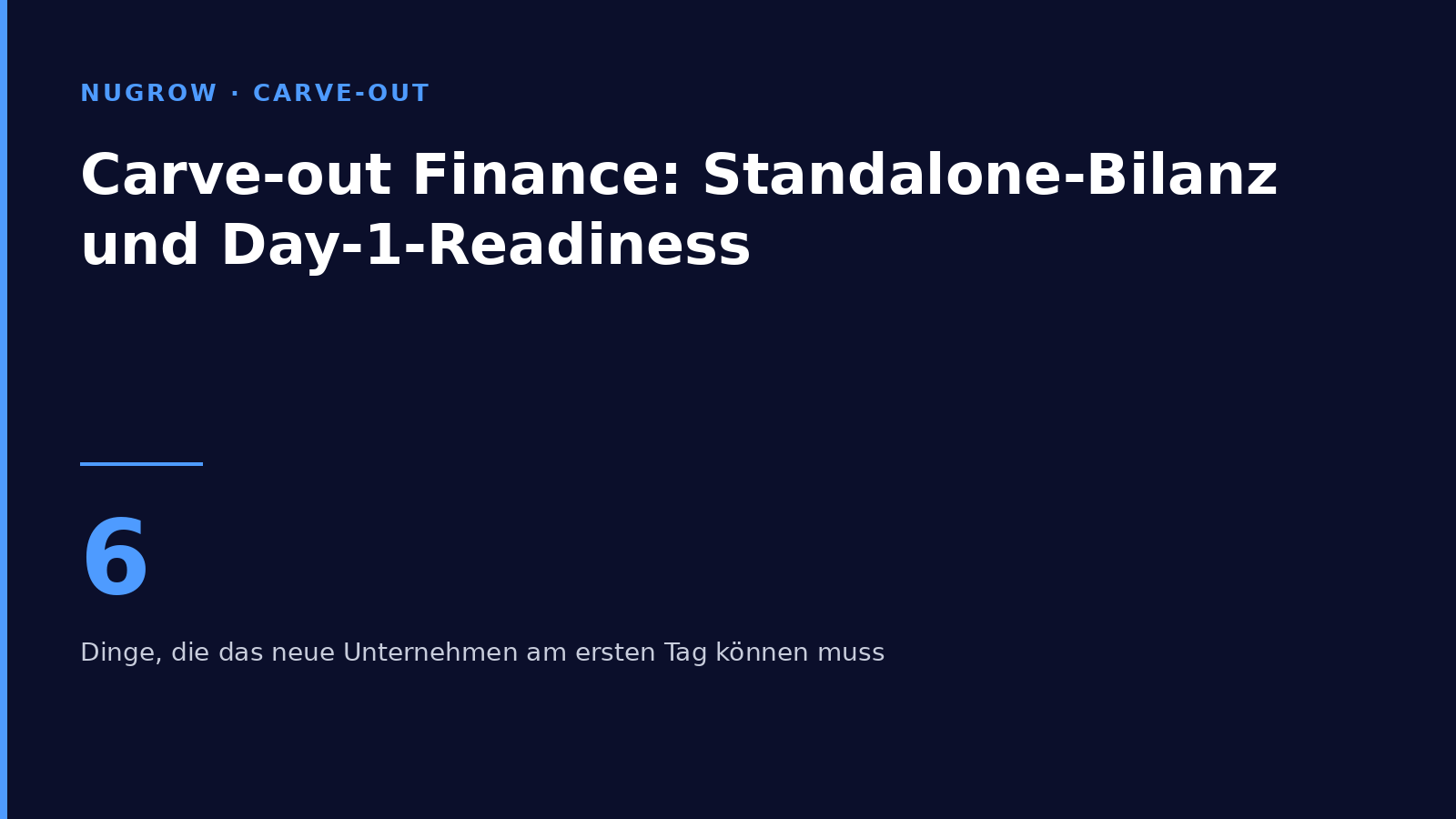
On the first day after closing the new company has to be able to do six things: issue invoices, release payments, pay wages, record transactions, file taxes and report to its shareholders. A manageable but unforgiving list hangs on that:
- Its own legal entity, tax numbers and VAT identification number. Authority lead times are among the most common risks to the timetable.
- Bank accounts and signing authority. Opening, identity verification, approval workflow – several weeks in practice.
- Its own accounting system with an opening balance sheet. Chart of accounts, master data, open items, fixed-asset register.
- Payroll. Transfer of employees, migration of personnel data, registrations with the social security bodies.
- Customer and supplier contracts. Novation, consents, new payment details in the counterparty's systems.
- A transitional services agreement for everything not ready on day one – with scope, prices, term and a binding end date.
That transitional agreement is the single most important lever in the whole project. Cut too short, it leaves the new company flying blind; drawn too long and too vaguely, it keeps the new company permanently dependent on the seller – and paying for it.
Timetable and staffing
Six to twelve months between the decision and day one is realistic, more where the system landscape is complex. The finance work starts at the beginning, not at the end: without solid standalone figures the unit cannot be marketed, and without an early decision on systems the date becomes untenable.
A carve-out needs staffing of its own. The existing divisional controller cannot run the project alongside the day job – and is needed at the same time as the future head of finance of the new company. That is exactly why an interim CFO is often the pragmatic answer in this constellation.
The five mistakes
- Rolling forward allocations instead of calculating real costs. A group allocation key never reflects the cost of running a standalone structure.
- Ignoring stranded costs. The seller notices only after closing that part of the overhead continues without the revenue that used to carry it.
- Touching IT too late. Separating the systems is almost always the critical path, not the balance sheet.
- Transitional services left vague. Without a statement of work and an end date it becomes a permanent arrangement with built-in conflict.
- No cash forecast of its own for the first quarter. The new company starts with no credit history; the 13-week forecast belongs before day one, not after it.
Frequently asked questions
What is the difference between a carve-out and a spin-off?
In a carve-out the unit goes to a buyer; in a spin-off it goes to the existing owners. The finance work – the standalone view, day-1 readiness, separating the systems – is largely identical.
Are carve-out accounts audited?
They can be prepared with auditor involvement, but they are not statutory accounts. They are a reconstruction based on defined assumptions. What matters is that the assumptions are documented and applied consistently throughout.
How long should a transitional services agreement run?
Six to eighteen months is common, staggered by function. Accounting and payroll move early, complex IT systems late. What matters is a fixed end date and a price that rises over time – otherwise there is no incentive to exit.
Who bears the cost of separation?
That is a matter for negotiation and belongs in the term sheet early. The amounts are substantial, and they resurface later in the EBITDA normalisation on both sides.
Read on
- Carve-out and carve-out balance sheet – the terms in brief.
- The first 100 days after closing.
- Interim CFO for private equity portfolios.
- Interim CFO – triggers, process and availability.
Sources and status
This article draws on nugrow's mandate practice in separation and integration projects. As of September 2026. This article is an overview and does not replace tax or legal advice.