
Who must file the German VAT advance return, and by when?
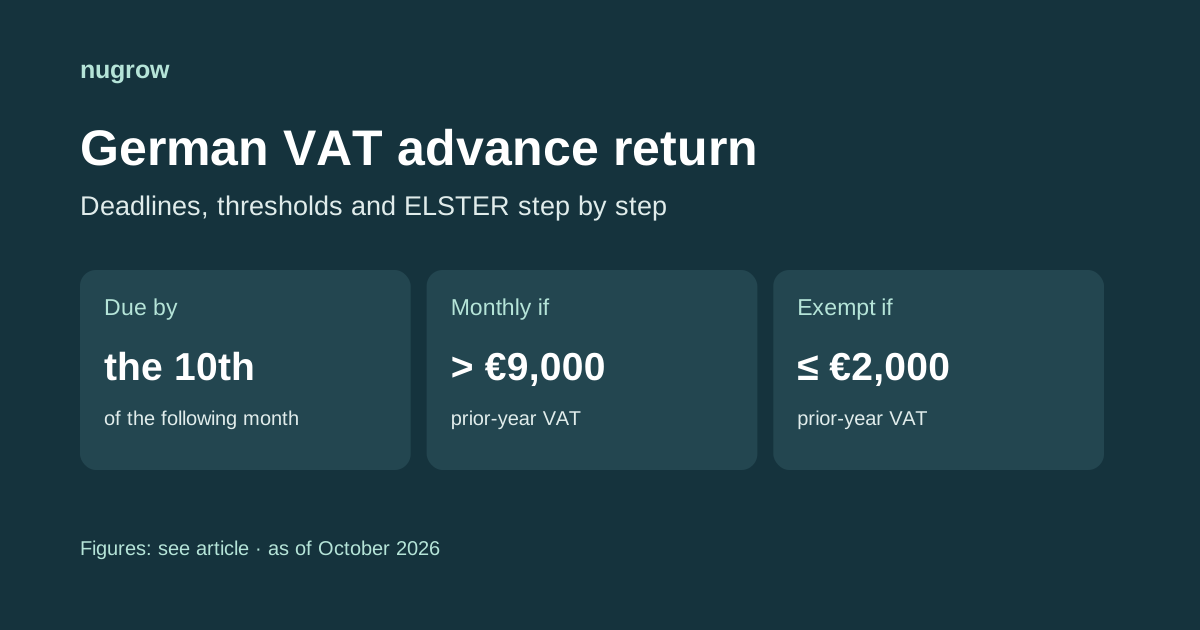
Businesses in Germany that charge VAT under the standard rules report their VAT electronically to the tax office — monthly or quarterly, depending on the previous year's VAT. Filing and payment are due by the 10th day after the end of the reporting period. Small businesses under Section 19 of the German VAT Act (Kleinunternehmer) do not file regular advance returns.
As of October 2026. This article describes German rules, is general information and does not replace tax advice. In individual cases the tax office decides on the reporting period.
Jump to a section: Monthly or quarterly? · Deadlines · Five-step guide · Common mistakes
Monthly, quarterly or not at all?
The reporting period depends on the previous year's VAT:
- More than 9,000 euros: monthly advance returns.
- More than 2,000 up to 9,000 euros: quarterly advance returns.
- Up to 2,000 euros: exemption from advance returns — VAT is then reported only in the annual return.
Special rules apply to founders. The obligation to file monthly in the founding year and the following year is suspended under current law for the 2021 to 2026 tax periods. Whether and how this continues afterwards is something to clarify with your tax advisor in the course of 2027. According to the Schwerin Chamber of Commerce (IHK, in German), small businesses do not file regular advance returns. Where the thresholds lie is explained in Taxes for freelancers and the self-employed in Germany.
Deadlines, filing extension and late-filing surcharge
The return and the payment are due by the 10th day after the end of the reporting period. For quarterly filers that means 10 April for the first quarter; for monthly filers, the 10th of the following month.
With a permanent filing extension (Dauerfristverlängerung), filing and payment shift by one month. The application is submitted electronically. Monthly filers additionally pay a special advance payment of one eleventh of the previous year's VAT, due by 10 February. Quarterly filers do not need a special advance payment.
For late filing, the tax office can impose a surcharge of at least 25 euros for each month or part thereof, capped at 10 percent of the assessed tax and at 25,000 euros.
The advance return in five steps
- Set up ELSTER access: The return must be submitted electronically and authenticated — paper is not permitted. Register early at elster.de so your certificate is ready for the first deadline.
- Pull the figures from your bookkeeping: You need the period's net revenue split by VAT rate and the input VAT from incoming invoices. Both come from the VAT and input-VAT accounts.
- Complete the form: Revenue at 19 and 7 percent goes into boxes 81 and 86, deductible input VAT from other businesses' invoices into box 66. The form calculates the advance payment (box 83). Box assignments can change — the current ELSTER form guides you through the fields.
- Check: Do the totals match the bookkeeping? Also verify that every input-VAT deduction is backed by a proper invoice.
- Submit and archive: Send the return, save the transmission record, and pay the balance on time or set up a SEPA direct debit mandate.
Many accounting tools submit the advance return directly to ELSTER. An overview is in DATEV alternatives for startups.
Common mistakes to avoid
- Entering gross instead of net amounts.
- Deducting input VAT without a proper invoice. Since 2025, businesses must be able to receive e-invoices — see E-invoicing in Germany instead of PDF by email.
- Choosing the wrong period or forgetting a period altogether.
- Using the filing extension without budgeting for the special advance payment.
- No reconciliation between bookkeeping and return. Discrepancies surface at the latest in the annual VAT return.
When support pays off
If receipts pile up, closings come late or several entities have to file, reliable bookkeeping is worth it. nugrow supports this with interim accounting and FP&A. What that looks like day to day is described in Interim accountants: bookkeeping on demand (in German).
Frequently asked questions
Do small businesses (Kleinunternehmer) have to file a VAT advance return?
No. Small businesses under Section 19 of the German VAT Act do not file regular VAT advance returns. Anyone who exceeds the thresholds and switches to standard taxation must file from that point on.
What happens if I miss the deadline?
The tax office can impose a late-filing surcharge of at least 25 euros per month or part thereof, capped at 10 percent of the assessed tax or 25,000 euros. File the return as soon as possible.
What does the permanent filing extension (Dauerfristverlängerung) do?
Filing and payment shift by one month. Monthly filers pay a special advance payment of one eleventh of the previous year's VAT, due by 10 February.
Sources and status
Thresholds, deadlines and surcharges under Section 18 of the German VAT Act and Section 152 of the German Fiscal Code, summarised after Steuerschroeder (in German, as of May 2026). The statements on small businesses come from the Schwerin Chamber of Commerce (IHK, in German). Always check the current status with ELSTER or your tax advisor before filing. As of October 2026.