
What do freelancers and the self-employed in Germany need to know about tax?
Freelancers (Freiberufler) and trade businesses (Gewerbetreibende) both pay income tax on their profit. Trade businesses additionally pay trade tax. Anyone staying below certain revenue thresholds can use the small-business rule (Kleinunternehmerregelung) and does not charge VAT. Profits are reduced above all through fully documented business expenses and the right depreciation.
As of October 2026. This article describes German rules, gives an overview and does not replace tax advice. Individual rules depend on your activity and legal form.
Jump to a section: Freelance or trade · Small-business rule · Business expenses · Depreciation · Common mistakes
Freelance or trade: the difference
Freelancers carry out an activity within the meaning of Section 18 of the German Income Tax Act — for example advisory, artistic or teaching work. They usually determine their profit with a simple cash-basis statement (Einnahmenüberschussrechnung) and pay no trade tax. Trade businesses register a trade, pay trade tax and must prepare full accounts above certain sizes. In case of doubt, the tax office decides whether your activity is freelance. Clarify this when you start — a later reclassification as a trade can trigger taxes retroactively.
Small-business rule: thresholds since 2025
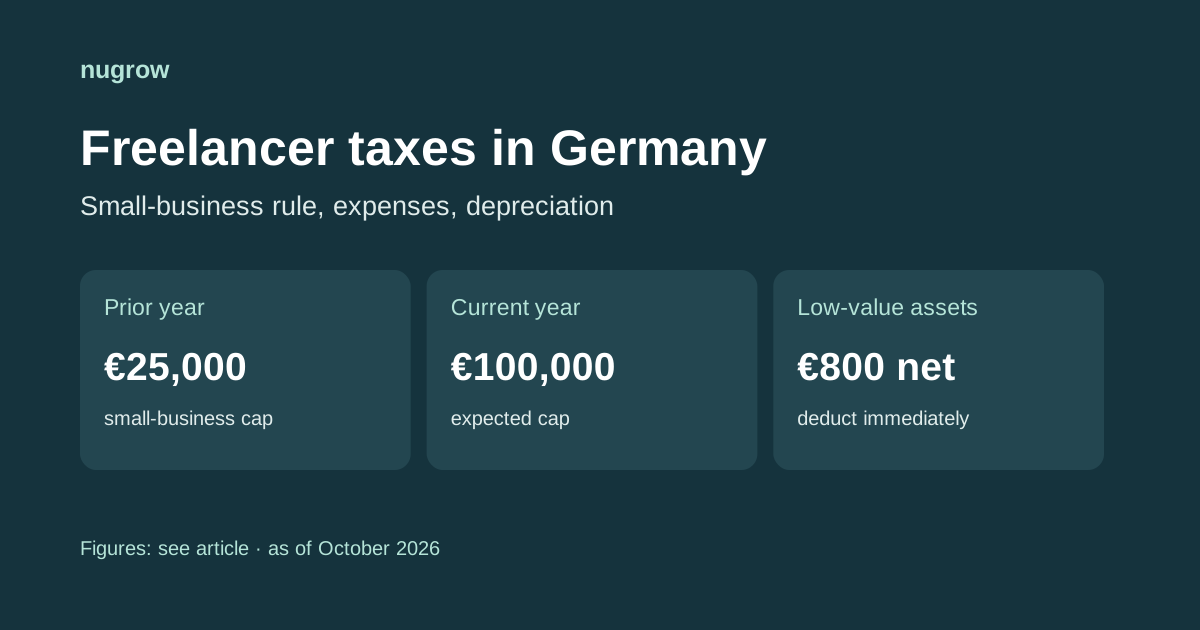
Since 1 January 2025, under Section 19 of the German VAT Act: your net revenue may not exceed 25,000 euros in the previous year and is expected not to exceed 100,000 euros in the current year. The former gross thresholds of 22,000 and 50,000 euros no longer apply. Source: Schwerin Chamber of Commerce (IHK, in German).
As a small business you do not charge VAT, do not file the regular VAT advance return and do not have to issue e-invoices. In return, you cannot deduct input VAT. This pays off above all with customers who cannot deduct VAT anyway, such as consumers. With business customers, standard taxation is often the better deal, because you recover the input VAT on your expenses. More on the invoicing rules: E-invoicing in Germany instead of PDF by email.
Business expenses: what you can deduct
Business expenses reduce your profit and therefore your tax. Deductible is whatever has a business purpose, for example:
- Work equipment, software and office supplies
- Training and professional literature
- Business insurance and professional dues
- Travel with a business purpose
- Phone, internet and advisory costs
- The home-office allowance or a dedicated office, each under the statutory conditions
Documentation is decisive. Keep every receipt, separate private and business expenses consistently, and record the business purpose for entertainment and travel. Clean bookkeeping makes this much faster — see DATEV alternatives for startups.
Depreciation: low-value assets and investment deduction
Fixed thresholds under Section 6 of the German Income Tax Act apply to purchases:
- Up to 800 euros net: low-value assets (GWG) are fully deducted in the year of purchase.
- Over 250 up to 1,000 euros net: alternatively you can form a pooled item that is written off over five years at one fifth each.
- Above that: the asset is depreciated over its useful life.
Thresholds per Steuerschroeder (in German, legal status June 2026). In addition, for planned purchases of movable assets you can recognise an investment deduction (Investitionsabzugsbetrag) of up to 50 percent of the expected cost in advance, reducing profit, provided your profit does not exceed the statutory limit. The purchase must actually follow — otherwise the deduction is reversed.
Common mistakes
- Missing or incomplete receipts and private expenses booked as business.
- Outdated thresholds: anyone still calculating with 22,000 and 50,000 euros may switch to standard taxation unnecessarily.
- No reserve for taxes: income-tax back payments and prepayments strain liquidity. Plan for them, as described in Cash flow management.
- Wrong classification as a freelancer despite partly commercial activity.
Different rules apply to startups organised as a GmbH. An overview is in Tax optimisation for startups (in German).
Frequently asked questions
Which thresholds apply to the German small-business rule?
Since 2025, net revenue may not exceed 25,000 euros in the previous year and is expected not to exceed 100,000 euros in the current year. The former thresholds of 22,000 and 50,000 euros no longer apply.
Up to what amount can I deduct purchases immediately?
Low-value assets up to 800 euros net can be fully deducted in the year of purchase. Between 250 and 1,000 euros net, a pooled item written off over five years is an alternative.
Do freelancers pay German trade tax?
No. Trade tax only applies to trade income. Freelancers pay income tax and, depending on their VAT status, VAT.
Sources and status
Small-business thresholds per the Schwerin Chamber of Commerce, low-value asset thresholds per Steuerschroeder (both in German); legal bases Sections 18 and 19 of the German VAT Act and Sections 6 and 7g of the German Income Tax Act. Verify current figures with your tax advisor before deciding. As of October 2026.