
Is a PDF invoice by email still enough in Germany?
For now, yes — but not for much longer. Since 1 January 2025, every business in Germany must be able to receive and process e-invoices. For issuing, transition periods apply: paper and PDF invoices may still be used domestically until the end of 2026, after which the structured e-invoice becomes mandatory step by step. A plain PDF file is not an e-invoice.
As of October 2026. This article summarises the German rules and does not replace tax advice.
Jump to a section: Timeline · What counts as an e-invoice? · Mandatory invoice details · Checklist
The timeline to 2028
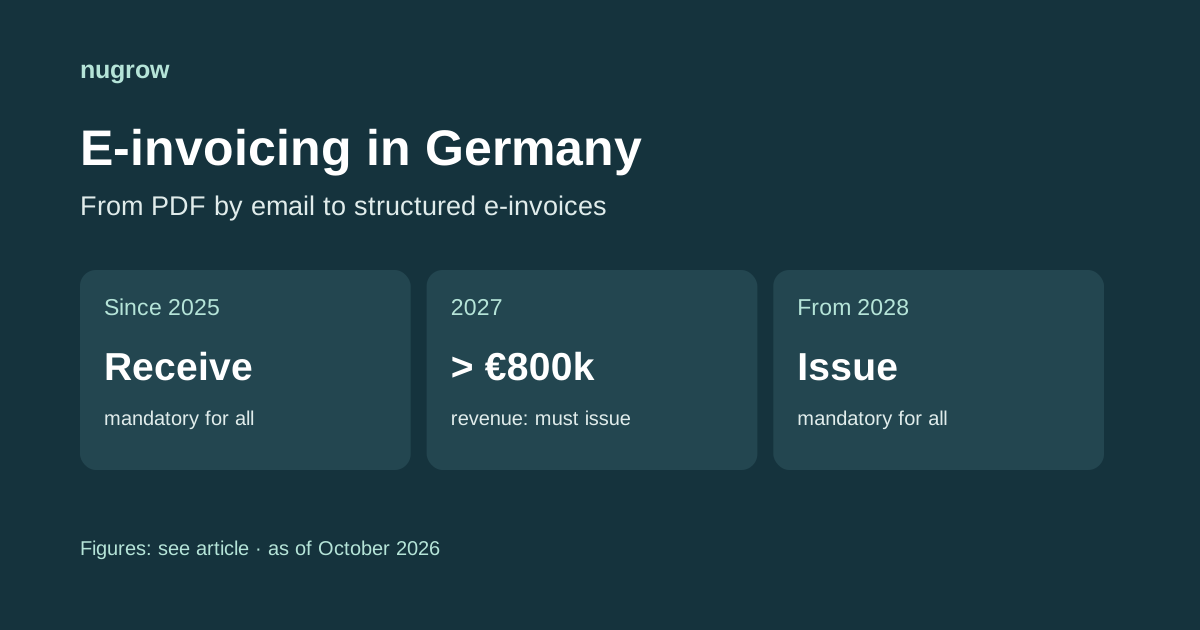
- Since 1 January 2025: All businesses must be able to receive and process e-invoices. The sender does not need prior consent.
- 2025 and 2026: Paper invoices and other formats such as PDF or JPG may still be issued; for electronic delivery, with the recipient's consent.
- 2027: Businesses with a previous-year turnover of up to 800,000 euros may continue to issue paper and PDF invoices. Larger businesses must issue e-invoices.
- From 2028: All businesses must issue structured e-invoices for domestic B2B transactions.
The obligation applies to transactions between businesses based in Germany. Invoices to consumers and to customers abroad are not covered.
What counts as an e-invoice?
An e-invoice is a structured data record that software can read automatically. It must comply with the European standard EN 16931. Permitted formats include XRechnung and ZUGFeRD (Factur-X) in suitable profiles. ZUGFeRD combines a human-readable PDF with the embedded data. Other formats are only permitted with the recipient's consent and do not count as e-invoices for the purposes of the mandate. Source: Erfurt Chamber of Commerce (IHK, in German).
Mandatory details on every invoice
Regardless of format, invoices must contain the mandatory details under Section 14 of the German VAT Act:
- Name and address of supplier and recipient
- The supplier's tax number or VAT identification number
- Issue date and a sequential invoice number
- Quantity and nature of the supply, and the date of supply
- Net amount, VAT rate and VAT amount — or, where applicable, a reference to a VAT exemption
If details are missing, the recipient's input-VAT deduction can be at risk. More on reporting VAT is in German VAT advance return 2026.
Exemptions and archiving
Small-value invoices up to 250 euros and transport tickets are exempt. Small businesses (Kleinunternehmer) do not have to issue e-invoices because they are exempt from VAT — but they should be able to receive e-invoices from business partners. Source: Schwerin Chamber of Commerce (IHK, in German).
E-invoices must be archived in the original structured format and in line with the German GoBD rules. A printout or the PDF view alone is not sufficient.
Checklist for businesses
- Secure receipt: Set up a mailbox that accepts e-invoices and define who checks and approves them.
- Check your software: Can your accounting tool write and read e-invoices? An overview is in DATEV alternatives for startups.
- Adapt your archive: Store the structured original in an audit-proof way, not just the PDF view.
- Maintain master data: Complete customer data, tax numbers and, for public-sector clients, routing IDs (Leitweg-IDs).
- Clarify processes: From invoice to payment to dunning. That also helps with receivables management (in German).
If you want to change process and software at the same time, nugrow supports the software implementation.
Frequently asked questions
Is a PDF invoice sent by email an e-invoice?
No. An e-invoice is a structured data record complying with the European standard EN 16931, for example XRechnung or ZUGFeRD. A plain PDF file does not meet this requirement. For domestic German invoices it is only permitted during a transition period.
Do small businesses have to issue e-invoices in Germany?
No, small businesses (Kleinunternehmer) do not have to issue e-invoices. They should, however, be able to receive and process e-invoices from business partners.
How must e-invoices be archived?
In the original structured format, in line with the German GoBD rules and the statutory retention periods. A printout or a PDF view alone is not sufficient.
Sources and status
Timeline, formats and exemptions after the Erfurt Chamber of Commerce and the Schwerin Chamber of Commerce (both in German). Check details such as format profiles and deadlines with the German Federal Ministry of Finance or your tax advisor before implementation. As of October 2026.