
What does cash flow management mean?
Cash flow management controls when money comes into the business and when it flows out. The goal is to stay solvent at all times — even when profit looks good. The most important levers are shorter payment terms for customers, consistent dunning, deliberately used supplier terms and a reserve for weak months.
Jump to a section: Profit and cash flow · Receivables · Payables · Reserve and forecast
Profit is not cash flow
Profit is an accounting figure derived from income and expenses. Cash flow shows the actual payments in and out. It has three parts: operating cash flow from the day-to-day business, cash flow from investing, and cash flow from financing — loans or shareholder payments, for example. Why the two can diverge is covered in EBITDA up, liquidity down.
Lever 1: collect receivables faster
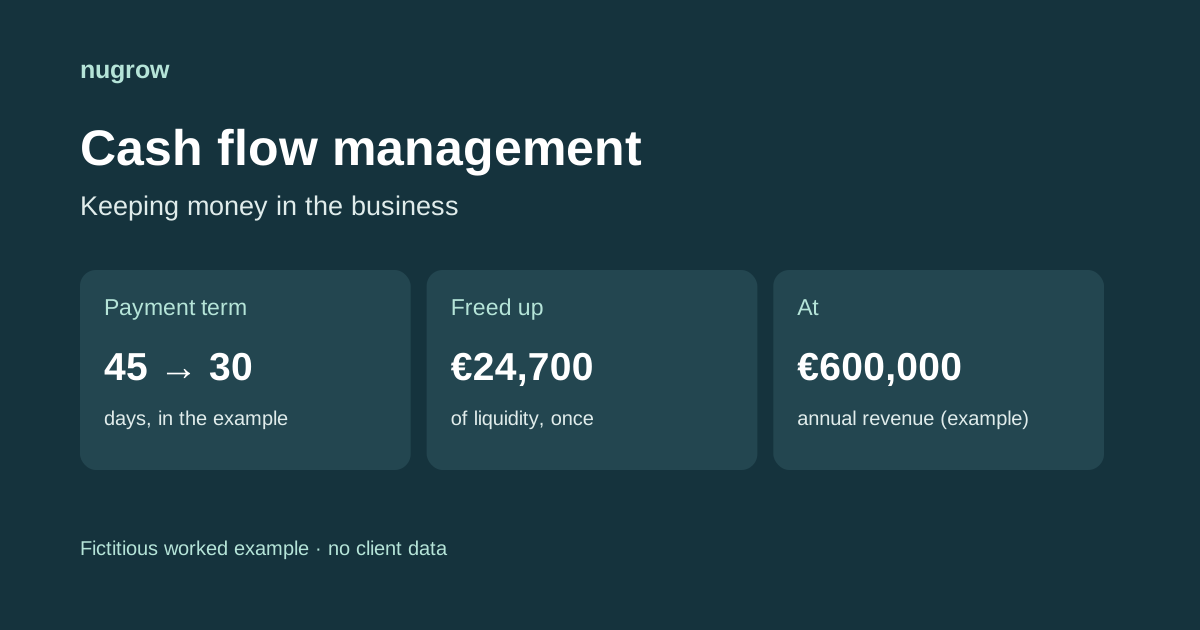
For most companies the biggest lever sits with customers. An example with fictitious numbers: a company generates 600,000 euros of net annual revenue. With an average payment term of 45 days, around 73,973 euros of receivables are outstanding on average. If the term drops to 30 days, it is around 49,315 euros. The difference of roughly 24,700 euros becomes available as liquidity — without a single euro of additional revenue. (Calculation: annual revenue divided by 365, times the payment term in days.)
- Invoice immediately after delivery, not batched at month end.
- Agree shorter payment terms, or deposits and interim invoices.
- Automate dunning with fixed stages and dates.
- Offer SEPA direct debit where it fits the customer relationship.
Which software helps is covered in receivables management software (in German).
Lever 2: manage payables deliberately
Supplier payment terms are an interest-free loan. Use them — but pay neither too early nor too late. For early-payment discounts, do the maths: a two percent discount for paying after ten instead of thirty days corresponds to an annualised rate of roughly 37 percent. If liquidity is available, that is almost always worth it. If it is tight, do not risk it for the discount.
Lever 3: reserve and forecast
A liquidity reserve absorbs weak months. As a rule of thumb, keep a bank balance covering at least one month of fixed costs. Just as important is looking ahead: a 13-week cash flow forecast shows when payments are due and where things get tight. Early-warning signs are described in Recognising a liquidity squeeze (in German). How receivables, inventory and payables interact is shown in Cutting working capital.
Short and compact
If accounting closings, payment monitoring and planning are missing, nugrow supports with interim accounting and FP&A.
Frequently asked questions
What is the difference between profit and cash flow?
Profit is an accounting figure derived from income and expenses. Cash flow shows the actual payments in and out. A company can report a profit and still become insolvent — for example because customers pay late or investments are due.
How quickly can cash flow be improved?
The fastest levers are shorter payment terms, immediate invoicing and consistent dunning. In the worked example, a payment term shortened by 15 days frees up around 24,700 euros at 600,000 euros of annual revenue.
Are early-payment discounts worth it?
Often yes, if the liquidity is there. A two percent discount for paying after ten instead of thirty days corresponds to an annualised rate of roughly 37 percent. If the liquidity is not available, do not risk it for the discount.
A note on the numbers
The worked example is fictitious and simplified. It ignores revenue seasonality, VAT and partial payments. As of October 2026.