
The short answer
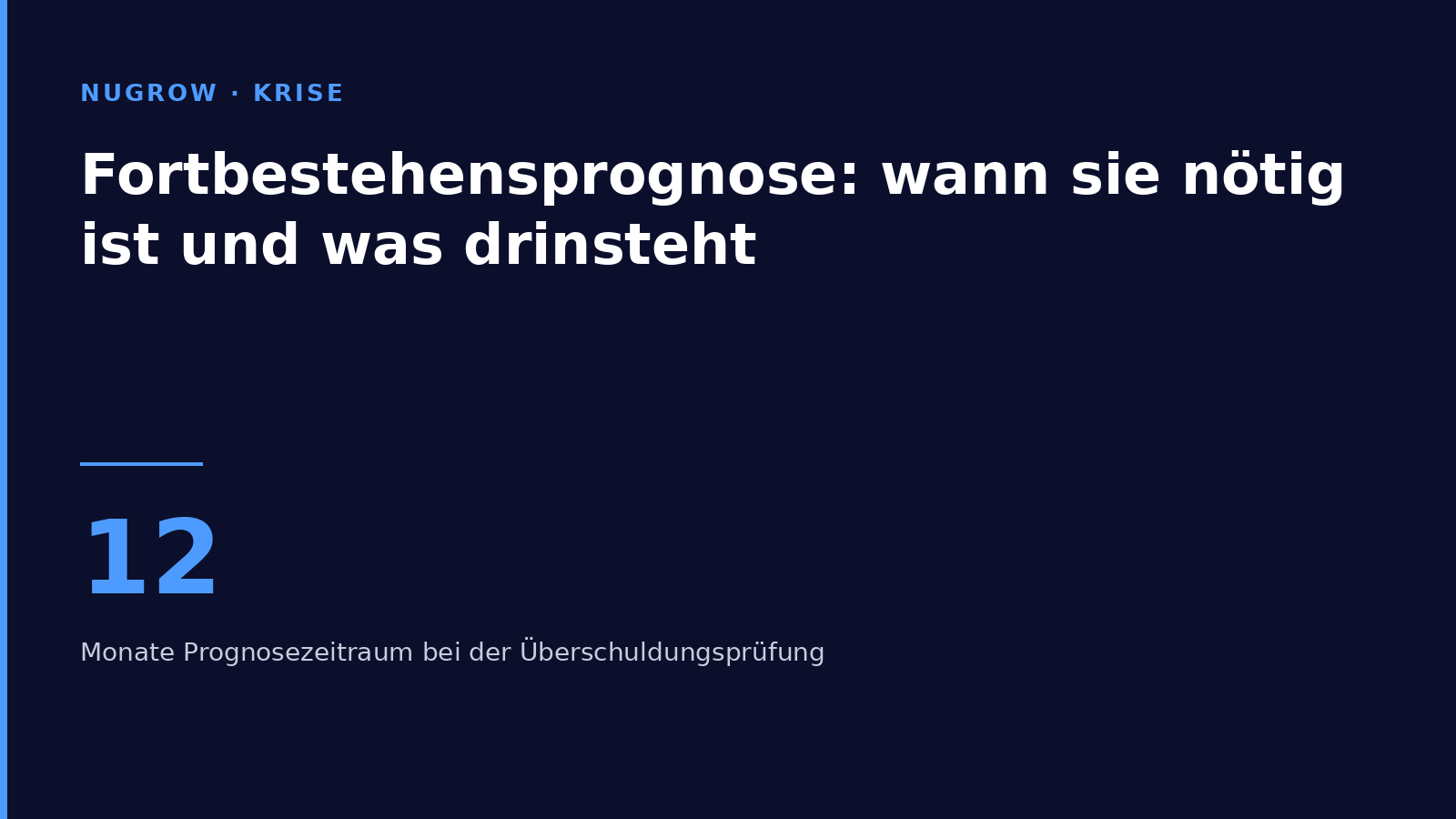
The Fortbestehensprognose — going-concern forecast — is a documented statement that a company will more likely than not be able to meet its payment obligations over the forecast period. It is the reason a balance-sheet deficit does not automatically lead to insolvency proceedings.
Under § 19 InsO, over-indebtedness (Überschuldung) exists only where assets no longer cover liabilities and continuation of the business is not more likely than not. A positive forecast removes the ground for filing — even with negative equity.
A note for readers outside Germany
In most jurisdictions going concern is an accounting judgement: the directors form a view, the auditor tests it, and the consequence is a paragraph in the accounts. In Germany it is that too, but it is first of all a liability document.
A managing director of a German GmbH who files late commits a criminal offence and is personally liable for payments made after insolvency has set in. The forecast is what stands between those two outcomes. It is not written for the auditor; it is written for the file, and it has to hold up when someone reconstructs the sequence of events afterwards.
The second point that regularly surprises foreign shareholders: negative equity in a German company is not by itself a filing obligation. It is a trigger to assess — and to document that the assessment happened.
When it is needed
- Balance-sheet over-indebtedness. Once equity is used up, management has to test, and record the test. The most common mistake is to do it in their heads.
- Sustained losses or a tight liquidity corridor, even where equity is still positive.
- The annual accounts. Measuring at going-concern values presupposes that continuation is likely. Auditors and tax advisers therefore ask for the forecast whenever the situation looks strained.
Two questions, two periods
The forecast is at its core a solvency forecast, not an earnings forecast. A company can be loss-making and still have a positive forecast, provided its funding is secured.
The forecast period for the over-indebtedness test is twelve months. It should not be confused with impending illiquidity under § 18 InsO, which looks out 24 months — that is not a ground for filing but the gateway to restructuring tools such as StaRUG.
Both are separate again from the filing deadlines: three weeks at the outside for illiquidity, six weeks for over-indebtedness, and those may only be used up where a restructuring is genuinely in prospect. The detail is in insolvency filing deadlines in Germany.
What the forecast contains
- Starting position. Reference date, entity, occasion, asset position, funding structure, causes of the crisis.
- An integrated twelve-month plan. P&L, balance sheet and cash, monthly, from one consistent model — not three separate spreadsheets.
- Weekly liquidity for the first quarter. A rolling thirteen-week cash forecast is the standard here. The question “is there enough money” gets answered week by week first, not month by month.
- Assumptions with evidence. Every load-bearing assumption needs a basis: order book, a signed contract, a shareholder commitment, a bank confirmation. Non-binding letters of intent do not carry weight.
- Measures with status. What is decided, what is implemented, what is merely planned. Only the first two may be taken at full value.
- Scenarios. A base case and a credible downside, plus a statement of the point at which the forecast tips.
- A concluding judgement, dated and signed by management.
The mistakes that get expensive
- Not documented. A forecast that was never written down is not a forecast when it is contested. The burden of proof sits with management.
- Earnings only. A profit plan without a cash forecast answers the wrong question.
- Non-binding support counted as funding. A parent's verbal willingness is not a commitment. What carries weight is a subordination agreement, a hard comfort letter, or a written commitment for a stated amount.
- Prepared once and filed away. The duty is continuous. If the position deteriorates materially, the test has to be redone immediately.
- Payments after insolvency has set in. These can trigger a personal reimbursement obligation for management — which is exactly why the date of determination matters so much.
Common questions
Who prepares the going-concern forecast?
Management is responsible. In practice it is produced by the finance function, in critical cases together with an adviser or auditor — particularly where third parties such as banks or shareholders are meant to rely on it.
How is this different from the going-concern assessment my auditor makes?
The auditor assesses whether the accounts may be prepared on a going-concern basis. The Fortbestehensprognose answers the insolvency-law question of whether continuation is more likely than not, and it is management's document, not the auditor's. In a strained situation the auditor will ask to see it.
What does it cost?
Almost entirely a function of the state of the planning. Where an integrated plan exists, it is a matter of days. Where it has to be built first, it becomes a project of several weeks — one more reason to establish planning capability before the crisis.
Is negative equity alone enough to trigger a filing obligation?
No. Over-indebtedness in the legal sense requires that continuation is also not more likely than not. That is why the forecast is the decisive document in this situation.
Can a parent company letter carry the forecast?
It can, if it is the right kind of letter. A hard comfort letter or a qualified subordination is load-bearing; a soft comfort letter is not. The distinction is set out in subordination agreements and comfort letters.
How often does it have to be updated?
As circumstances require, which in practice means monthly for as long as the position is tight. The basis is the running plan-versus-actual comparison of the cash forecast.
Read on
- The 13-week cash flow forecast – the instrument the first quarter of the forecast is built on.
- Subordination agreements and comfort letters – the two instruments a shareholder uses to support the forecast.
- Insolvency filing deadlines in Germany – the three- and six-week limits and what starts them.
- Finance in a restructuring – the first six weeks.
- Converting from HGB to IFRS – the other German accounting question foreign shareholders run into.
- Covenant reporting – what lenders expect while the position is tight.
- Interim management – where the planning and the forecast have to be built at short notice.
Sources and status
Legal references are to the German Insolvency Code (§§ 15a, 17, 18, 19 InsO) in its current form. As of September 2026. This article is an overview and does not replace legal advice. In a crisis, assessing insolvency is a matter for qualified advisers.