
The short answer
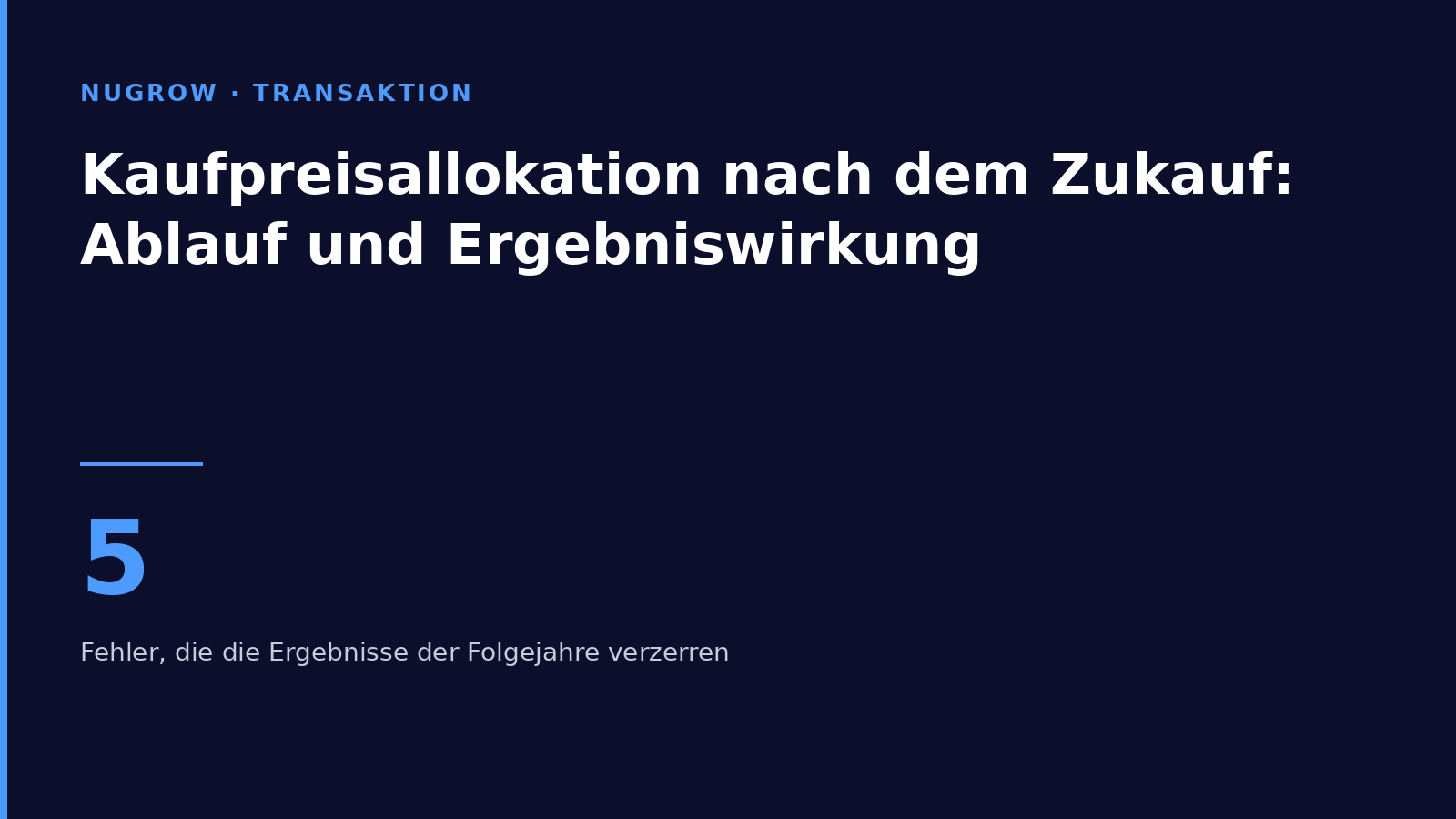
A purchase price allocation answers one question: what exactly was the purchase price paid for? The price is allocated to the assets and liabilities acquired at fair value; whatever cannot be allocated remains as goodwill.
It is not a formality but a decision about earnings. Whatever is allocated to customer relationships, technology or brands is amortised over its useful life and weighs on the coming years – at different speeds.
Why this matters more in Germany than a foreign parent expects
Under HGB, goodwill is amortised over its useful life; where that life cannot be estimated reliably, the law prescribes ten years. Under IFRS there is no scheduled amortisation – goodwill is tested annually for impairment instead.
For a buy-and-build programme run out of a German holding company that difference compounds: every acquisition adds an amortisation charge that runs for a decade, so reported group earnings fall year after year even as the operating business grows. Sponsors used to IFRS reporting are regularly surprised by it – and their covenant and bonus definitions often are not written for it.
What gets valued
In the first step the acquired company's book values are lifted to fair value: land, machinery, inventory, provisions. In the second step, assets are added that never sat on the acquired company's balance sheet:
- Customer relationships and order backlog. In most transactions the largest single item, valued on the expected future surplus from the existing business less a charge for the supporting assets.
- Technology and software. Usually via the royalties saved.
- Brands and naming rights. Also via royalties saved, depending on recognition and intended further use.
- Contractual advantages such as favourable lease or supply terms.
What remains is goodwill – economically the workforce, synergies and market position, which cannot be recognised individually.
The earnings impact
The more of the price that falls on short-lived intangibles – an order backlog with a useful life of one to two years, say – the more heavily the transaction weighs on the first years after the acquisition. Anyone building an earnings plan after an acquisition without these amortisation charges plans systematically too well.
That feeds directly into covenants and bonus arrangements. Metrics based on EBITDA are unaffected, because amortisation is not in it – metrics based on net income or equity are not.
The process
- Determine the acquisition date and the consideration. When did control pass, and what forms part of the consideration – including contingent elements such as earn-outs?
- Take stock. Which assets and liabilities were acquired, including those not previously recognised?
- Value them. Determine fair values, usually with external support for the intangibles.
- Set and justify useful lives – the point the auditor looks at most closely.
- Determine the residual and document it.
- Carry it into planning and reporting, including the future amortisation schedule per item.
When it should be done
As soon as possible after closing, and at the latest for the first set of accounts that includes the company. The reason is practical: the valuation rests on assumptions as at the acquisition date – customer lists, churn rates, order backlog, the plan. Wait two years and you reconstruct that basis laboriously and vulnerably.
Much of it already exists: run the buyer's review properly and the customer analyses and planning data can be taken straight from the data room.
The typical mistakes
- Everything into goodwill. Convenient, but neither defensible in an audit nor informative – and, where intangible lives are short, worse for reported earnings.
- Useful lives without a rationale. Ten years for customer relationships is not a standard but an assertion that has to be derived from churn data.
- Forgetting the earn-out. Contingent price elements belong in the consideration, not in later years.
- Overlooking deferred tax. Recognising hidden reserves creates deferred tax liabilities in the consolidated balance sheet – which in turn increase goodwill.
- Not replanning earnings. The amortisation schedule belongs in the acquirer's plan before the first variance has to be explained.
Frequently asked questions
Does a small acquisition need a purchase price allocation?
As soon as consolidated accounts are prepared, yes. In a standalone set of accounts without consolidation the investment carrying amount simply stays – the question arises once a consolidated set of accounts is added.
Who carries it out?
Valuing the intangibles is normally a valuation specialist's job; embedding it in the accounts, the plan and the reporting is the finance function's. With several acquisitions, one consistent methodology beats a fresh approach per deal.
What does it cost?
The effort depends on the number of assets to be valued and on the state of the data. Existing customer cohorts and a reliable plan reduce it considerably.
Can the earnings impact be shaped?
It is not shaped – but the ranges for useful lives and valuation methods are real. What matters is justifying the line taken and applying it identically to every acquisition.
Read on
- Consolidated accounts after buy-and-build – where the allocation feeds in.
- EBITDA normalisation – the view before the purchase.
- Purchase price mechanics – how the consideration is put together.
- Interim CFO for private equity portfolios.
Sources and status
Legal references are to the German commercial law provisions on initial consolidation and on the amortisation of goodwill, and to IFRS 3. As of September 2026. This article is an overview and does not replace tax or legal advice.