
The short answer
In a finance function, what can be automated reliably today is whatever is rule-based and repeatable: document capture, incoming invoices, matching payments to open items, reconciling accounts, approval workflows and preparing reports. What cannot be automated is whatever requires judgement: measurement questions, cut-off decisions in edge cases, assessing unusual transactions, and anything somebody ultimately has to answer for.
The practical difference is rarely the technology. It is whether the preconditions are in place: a chart of accounts that permits analysis, documented processes and clear approval paths. Without those three, you are automating chaos.
The trigger most people underestimate: mandatory e-invoicing in Germany
Since 1 January 2025 every company established in Germany must be able to receive and process e-invoices in B2B transactions – including small businesses and sole traders. The recipient's consent is no longer required; an email inbox is a sufficient receiving channel.
For issuing invoices, transition periods apply:
| From | Who | What applies |
|---|---|---|
| 1 January 2025 | all companies established in Germany | must be able to receive e-invoices |
| until 31 December 2026 | everyone | paper and simple PDF still permitted if the recipient agrees |
| 1 January 2027 | companies with more than EUR 800,000 prior-year turnover | must issue e-invoices; paper and simple PDF no longer permitted |
| 1 January 2028 | all companies established in Germany | obligation to issue for domestic B2B transactions |
Exempt are invoices below EUR 250, travel tickets, sales to consumers, and issuing by small businesses under the Kleinunternehmer rule.
For automation, this is the real turning point. An e-invoice is a structured data set, not a picture of an invoice. That removes the step where most errors used to arise: reading the document. Anyone setting up processes now is building them on a data quality that did not exist before.
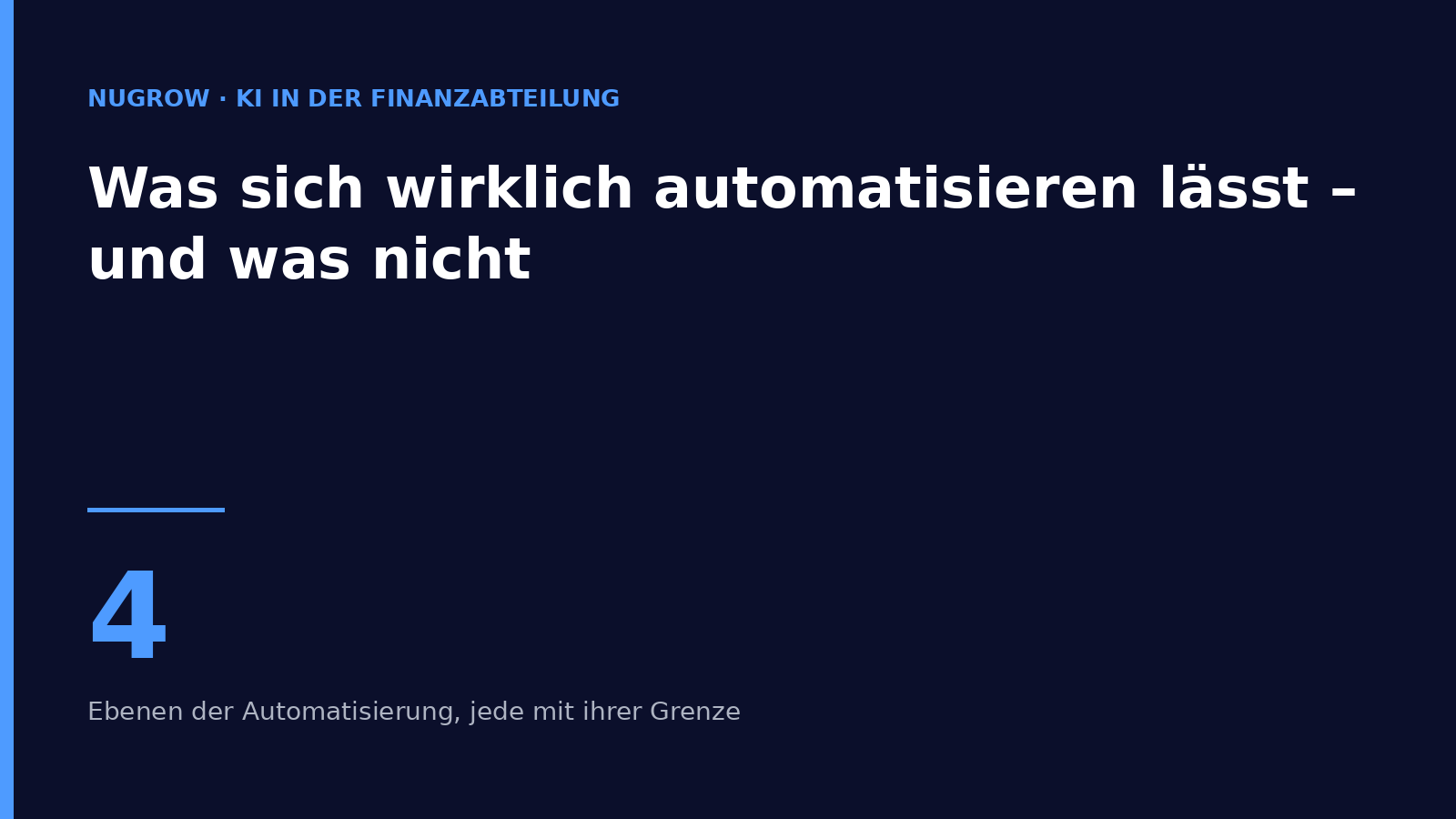
The four layers – and what really works on each
Layer 1: Capture
Works reliably. Document recognition from PDF and photo is mature; with e-invoices it disappears entirely. Incoming payments can be matched to open items by rules, including bulk transfers and partial payments. Invoices from marketplaces and payment service providers can be split automatically.
Where it breaks: handwritten documents, foreign languages with unusual layouts, invoices without a clear reference.
Layer 2: Coding
Works most of the time. Recurring transactions – rent, software subscriptions, telephone, vehicle costs – are coded very accurately after a short learning period. The suggestion is usually better than that of a newly trained assistant.
Where it breaks: edge cases. A document that separates a capital expenditure from an operating expense, an invoice with mixed VAT rates, a cut-off across the year end, intra-Community transactions, reverse charge. Here a model proposes something wrong with high confidence – and that is more dangerous than no proposal at all. These cases need a rule that routes them out for review.
Layer 3: Reconciliation
Works well and is underrated. Bank reconciliation, receivables and payables matching, reconciling payment-provider payouts against individual transactions, intercompany matching. This is the work that delays closes, and it is rule-based enough to hand over largely.
Where it breaks: differences. Automation finds them; it does not resolve them. Without an organised clearing process you end up with a faster list of unresolved items.
Layer 4: Steering and analysis
Works partially. Assembling reports, flagging variances, proposing wording for commentary, answering questions about the numbers in natural language – all of that is possible today and saves real hours.
Where it breaks: the explanation. Only someone who knows the business knows why a variance arose. A model will formulate a plausible reason even when it is wrong. For investor or bank reporting that is a serious risk.
What cannot be automated, and why
Responsibility. Annual accounts are signed by people. Management is liable for the books. A model cannot take on that responsibility, and no software removes it.
Measurement. Provisions, bad-debt allowances, valuation of work in progress, useful lives – these are judgement calls with ranges. The calculation can be automated; the decision about the assumption cannot.
Unusual transactions. Precisely the cases where it gets expensive are the ones with too few examples. A system that learns from repetition is weakest on the one-off.
The three preconditions, without which it fails
A chart of accounts that fits the question. If personnel costs sit in one lump and marketing is not split by channel, even the best automation only delivers the same unusable analysis faster.
Process documentation. German GoBD rules require it to be traceable how documents enter the system, how they are processed and how they are archived unalterably. With automated processes this documentation is not a formality; it is the basis on which a tax audit accepts the books.
Defined approval paths. Who may approve which invoice up to what amount, what happens during absences, when a four-eyes principle applies. Without those rules you automate a process that does not exist.
One detail that is often missed: since 1 January 2025 accounting vouchers – incoming and outgoing invoices, bank statements, delivery notes – have a retention period of eight years instead of ten, introduced by Germany's Fourth Bureaucracy Relief Act. For books, annual accounts, inventories and the process documentation itself, ten years still applies. Anyone automating their archive should map those two periods separately.
The sequence that works
- Clean up before automating. Review the chart of accounts, define approval paths, write the process documentation. This is the unpopular part and the one that decides success.
- Incoming invoices and payment matching. Biggest time saving, lowest risk, immediately measurable in the day the monthly close is finished.
- Reconciliation. Bank, receivables, payables, payment providers.
- Coding proposals with a rule that routes edge cases out for review.
- Reporting. Last, because it has the lowest tolerance for error.
Starting in the reverse order – which happens often, because reporting is the most visible – means building on data that will not carry the weight.
Frequently asked questions
What can AI automate in accounting?
Reliably: document recognition, incoming invoices, matching payments to open items, account reconciliation, approval workflows and preparing reports. Coding proposals work well for recurring transactions but need a review step for edge cases. What cannot be automated is measurement decisions and responsibility for the accounts.
When does e-invoicing become mandatory in Germany?
All companies established in Germany have had to be able to receive e-invoices since 1 January 2025. Companies with more than EUR 800,000 prior-year turnover must issue them from 1 January 2027, everyone else from 1 January 2028. Until the end of 2026, paper and simple PDF remain permitted with the recipient's consent.
What does automating a finance function cost?
Software licences are rarely the large item. What matters is the effort for preparation and implementation: chart of accounts, process definition, process documentation, migration and training. As a rule of thumb that effort exceeds the first year's licence cost – budgeting for the licence alone means budgeting too tightly.
Does AI replace the accounting team?
No. It shifts the work from capture to review and clearing. In practice the effort for recurring transactions falls sharply while the share of edge cases, reconciliation differences and measurement questions stays the same – it simply makes up a larger part of the remaining time.
What is process documentation and do I need it?
It describes how documents enter the system and are processed, checked and archived unalterably. The GoBD require it; with automated processes it is the basis on which a tax audit accepts the books. Automating without it means the actual risk has not been addressed.
Read on
- Interim accounting & FP&A – for when bookkeeping should not just be automated but reinforced for a defined period.
- Purchase-to-pay automation – what the term covers and why the purchase order rate decides whether it works.
- Automation rate – the straight-through processing rate as an honest metric.
- Finance as a Service – the outsourced finance function at a glance.
- CFO as a Service: modules and pricing models – which scope fits which stage.
Sources
E-invoicing deadlines under the German Growth Opportunities Act (Wachstumschancengesetz): overviews from DATEV, Haufe and the German chambers of commerce on the state of the legislation. Reduction of the retention period for accounting vouchers from ten to eight years: Fourth Bureaucracy Relief Act, promulgated in the Federal Law Gazette on 29 October 2024, applicable to documents whose ten-year period had not yet expired on 31 December 2024; for credit and financial services institutions the ten-year period still applies. Requirements for process documentation and unalterable archiving: GoBD. As of September 2026. This article is not a substitute for tax or legal advice.