

Break-even point: what it means, how to calculate it & a free break-even calculator
Why does the break-even point matter so much?
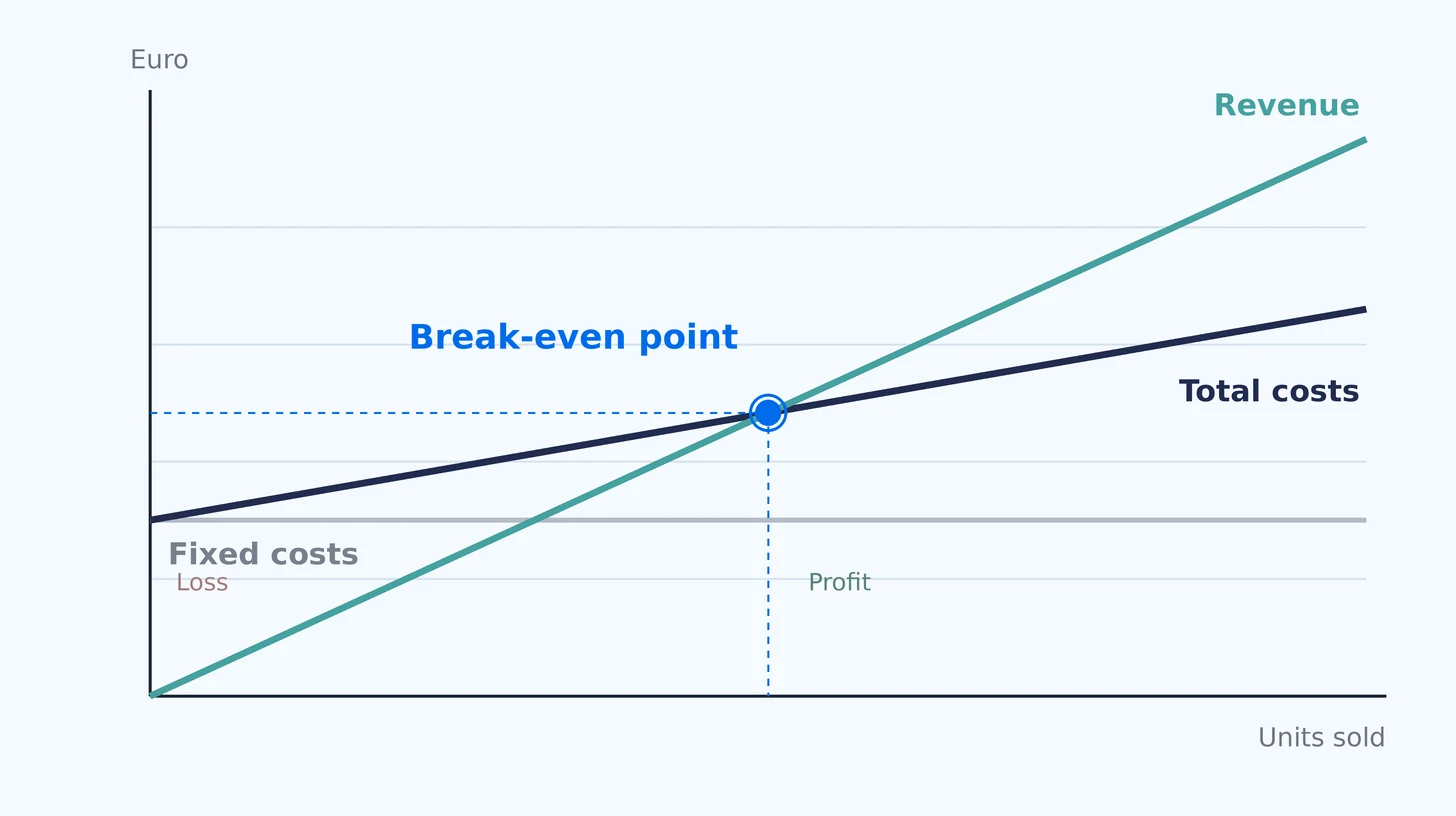
The break-even point (BEP) is one of the most important financial metrics a company has. It marks the point at which a business makes neither a profit nor a loss – the point where costs are exactly covered by revenue. For startups and established companies alike, knowing when an investment starts to pay off is essential.
Key takeaways:
- The break-even point is the revenue threshold above which a company becomes profitable.
- Calculating it helps you optimise pricing, cost structures and revenue targets strategically.
- A break-even calculator simplifies the maths and gives you results in seconds.
- Knowing your BEP allows for sound business planning and lower risk.
- Companies can deliberately optimise their break-even point to reach profitability faster.
What is the break-even point?
The break-even point is the sales revenue or unit volume at which a company's total costs are exactly covered by its income. Every euro above it is profit, every euro below it is a loss.
What influences the break-even point:
- Cost structure: the higher your fixed costs, the higher your break-even point.
- Pricing strategy: a selling price that is set too low pushes the break-even point up unnecessarily.
- Sales strategy: efficient marketing helps you reach the required sales volume faster.
The formula for calculating the break-even point:
Break-even point = fixed costs / (selling price per unit - variable costs per unit)
Example:
A company has the following cost structure:
- Fixed costs: 10,000 euros per month
- Variable costs per product: 5 euros
- Selling price per product: 20 euros
Calculation:
Break-even point = 10,000 / (20 - 5) = 667
In other words, the company has to sell at least 667 units per month to cover its fixed costs.
Use our free break-even calculator:
Want to work out your break-even point quickly and easily? Enter your own figures in our break-even calculator and get your result right away.
Break-even calculator
Strategies for improving your break-even point:
1. Cut fixed costs:
- Lower rent through flexible working (e.g. co-working spaces)
- Outsource tasks to reduce fixed costs
2. Reduce variable costs:
- Look for cheaper suppliers for materials
- Streamline production processes
3. Adjust selling prices:
- Charge higher prices by creating more value
- Use upselling and cross-selling strategies
Conclusion: how the break-even point shapes your business
The break-even point is a core metric that helps every business owner judge how profitable the company really is. By calculating it deliberately and adjusting your cost structure, you can reach profitability faster.
Frequently asked questions (FAQ):
1. How often should the break-even point be calculated?
- It is worth reviewing your break-even point regularly.
2. How can you reach the break-even point faster?
- By cutting fixed costs, optimising variable costs and running an effective sales strategy.
3. Is the break-even point equally important in every industry?
- Yes, although how much weight it carries varies by industry.
4. Which mistakes should you avoid when calculating it?
- Overly optimistic revenue forecasts and overlooked hidden costs both lead to miscalculations.